The Philippines has notched a notable jump in global tourism competitiveness, but structural hurdles continue to keep the country trailing its Southeast Asian neighbors.
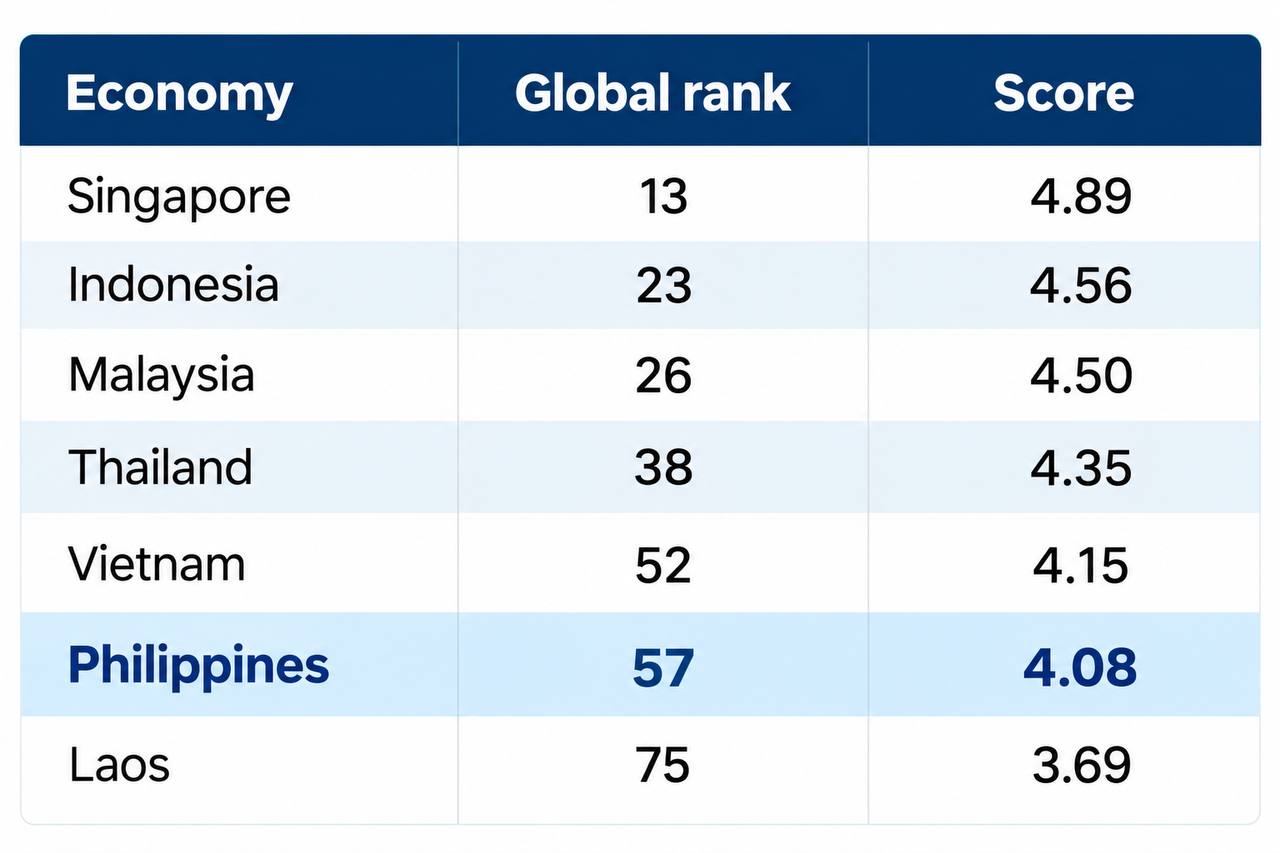
Climbing eight spots to 57th out of 110 economies in the World Economic Forum’s Travel & Tourism Development Index 2026, the Philippines scored 4.08 out of seven. This marks a 5.5% improvement from its 2024 performance and a 12-place surge from its pre-pandemic 2019 ranking of 69th.
Despite these progressive gains, the country remains rooted at sixth place among seven Southeast Asian economies evaluated in the index.
It continues to lag behind regional powerhouses Singapore (13th), Indonesia (23rd), Malaysia (26th), Thailand (38th), and Vietnam (52nd), with only Laos trailing behind at 75th.
Positioned by the WEF as one of the world’s 10 largest emerging tourism economies—a group driving over 28% of global direct tourism GDP—the Philippines faces immense pressure to fast-track crucial upgrades.
The index underscores that closing the regional gap hinges on aggressive investments in foundational infrastructure, workforce capabilities, streamlined visitor services, and capital deployment.
Globally, advanced economies dominated the upper echelons, with Japan securing the top spot followed by the United States and Spain, while China stood as the sole developing nation in the top 10.
Although the broader Asia-Pacific region emerged as a powerhouse for rapid infrastructure and resource development, local business analysts note that the Philippines must sharpen its execution on domestic reforms.
Without targeted interventions in logistics and hospitality training, the country risks missing out on its full economic potential within the booming regional tourism market.