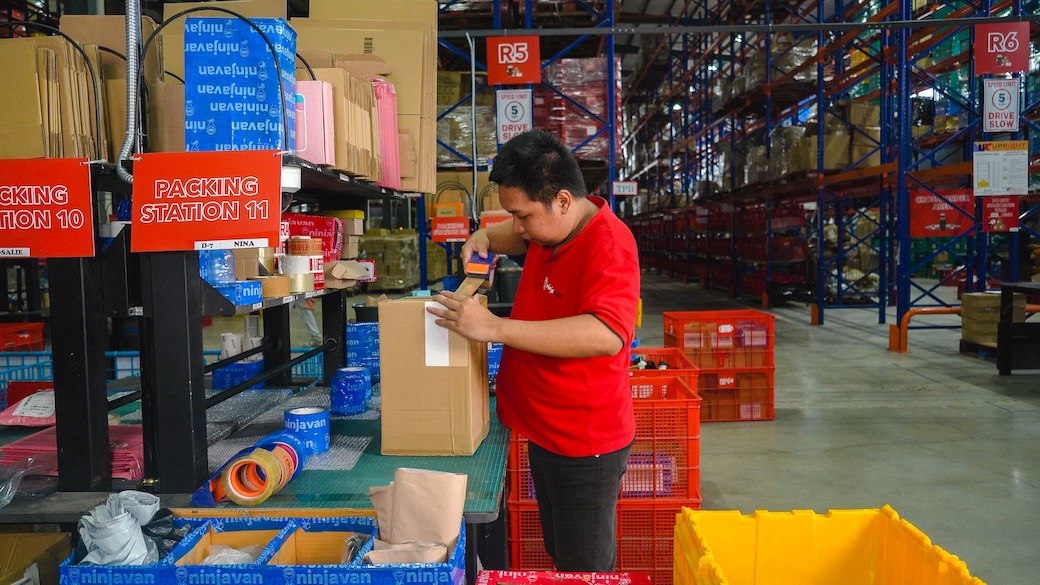
Ninja Van Philippines has opened a fulfillment warehouse in Cebu as it expands its regional logistics network, seeking to help businesses cut delivery times and transportation costs as e-commerce demand spreads beyond Metro Manila.
Unlike conventional courier facilities that handle parcels already packed by sellers, a fulfillment warehouse stores businesses’ inventory and manages the process of picking, packing, and preparing customer orders for shipment. This allows companies to outsource order processing and delivery to Ninja Van rather than maintain their own warehousing operations.
The 1,291.32-square-meter facility in Danlag, Consolacion, which began operations in late October, can process up to 10,000 orders daily. It will serve both business-to-consumer (B2C) and business-to-business (B2B) requirements, including instant and quick commerce.
The expansion addresses the cost and delivery constraints of relying on centralized warehouses in Luzon to serve customers across the Visayas and Mindanao. Positioning inventory closer to regional markets could reduce long-haul shipments, improve delivery lead times, and provide businesses with greater flexibility in managing stocks.
“Logistics can no longer operate on a one-size-fits-all model, particularly in a geographically diverse market like the Philippines,” said Erick Ramos, head of fulfillment at Ninja Van Philippines.
Beyond online orders, the Cebu hub will also support the replenishment of physical retail outlets, allowing businesses to distribute stocks to regional stores without waiting for shipments from Manila.
Astron and GOMO are among the facility’s early adopters, supporting their fulfillment requirements across the region. Ninja Van expects its workforce at the warehouse to double from an initial 50 employees to 100 as operations expand.
The Cebu investment is part of a broader push to decentralize the company’s fulfillment network. Ninja Van is also developing a South Luzon facility targeted for completion in the fourth quarter of 2026, alongside a planned Davao warehouse to strengthen coverage in Mindanao. A separate facility in Pampanga is scheduled to open in March 2027.
The planned hubs reflect the growing importance of regional inventory positioning as online sellers and retailers seek to serve customers outside major urban centers more efficiently.
For logistics providers, however, adding warehouse capacity is only part of the equation. The commercial value of a distributed network will ultimately depend on whether order volumes across regional markets can sustain the additional facilities and translate into consistently faster, more economical deliveries.
Ramos said the company aims to give businesses fulfillment options that support expansion into new markets without adding unnecessary supply chain complexity.