Land reclaimed from Manila Bay remains broadly stable at the surface, but beneath that stability, ground subsidence is continuing and is likely to persist, according to a satellite-based study by researchers from the Department of Geodetic Engineering at the University of the Philippines Diliman.
Published in The International Archives of the Photogrammetry Remote Sensing and Spatial Information Sciences, the study examined vertical ground deformation in the Manila Bay Freeport Zone between 2018 and 2021, a period marked by rapid construction and intensifying coastal development pressure.
Using Persistent Scatterer Interferometric Synthetic Aperture Radar, or PS InSAR, the researchers monitored subtle vertical ground movements across reclaimed areas. The technique, which relies on stacks of satellite radar images, allows millimeter-level detection of surface deformation over time at a fraction of the cost of traditional ground-based surveys.
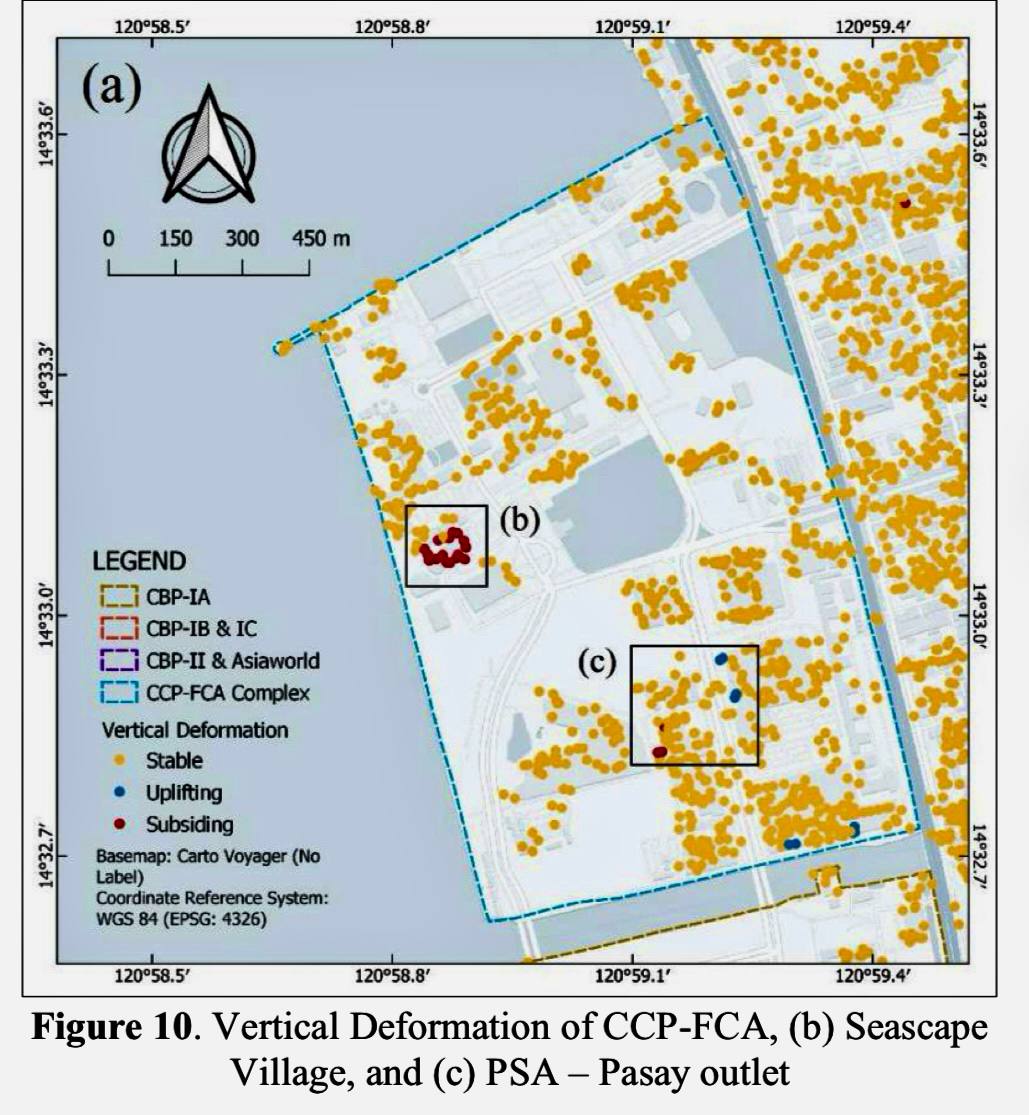
At a macro level, the findings point to relative stability. The average vertical deformation rate across the study area was measured at approximately minus 2.06 millimeters per year. However, the aggregate masks localized zones of subsidence, particularly in areas affected by differential settlement and nearby high-rise construction.
Those localized movements matter. As the Philippines pushes reclamation as a response to land scarcity, especially in coastal urban centers, reclaimed ground is increasingly being asked to support dense, heavy infrastructure. Unlike natural land, reclaimed areas are typically built on unconsolidated marine sediments and fill materials that settle unevenly under load.
To isolate true vertical movement, the UP Diliman team combined radar data from both ascending and descending satellite orbits and decomposed line-of-sight measurements using the Nearest Neighbor Vector approach. These results were then validated against annual leveling data from six benchmarks, yielding correlation coefficients above 0.80, a strong indicator of accuracy.
Clusters of subsiding points were detected near newly developed sections of the Freeport Zone, including areas close to Seascape Village. Field inspections corroborated the satellite data, revealing cracks and gaps near subsiding locations, visible signs that even small vertical shifts can translate into structural stress.
The researchers emphasize that reclamation itself is not inherently flawed. The risk lies in assuming that reclaimed land becomes geologically quiet once development begins. Subsidence, they note, can continue long after reclamation is completed, increasing exposure to flooding, storm surges, and long-term infrastructure damage as sea levels rise.
The study suggests continuous monitoring as standard practice. PS InSAR provides a scalable, cost-effective way to track sustained settlement, detect building-level deformation, and identify emerging risk zones early. As reclamation expands nationwide, vigilance beneath the surface may determine whether these projects deliver durable economic value or accumulate hidden liabilities.