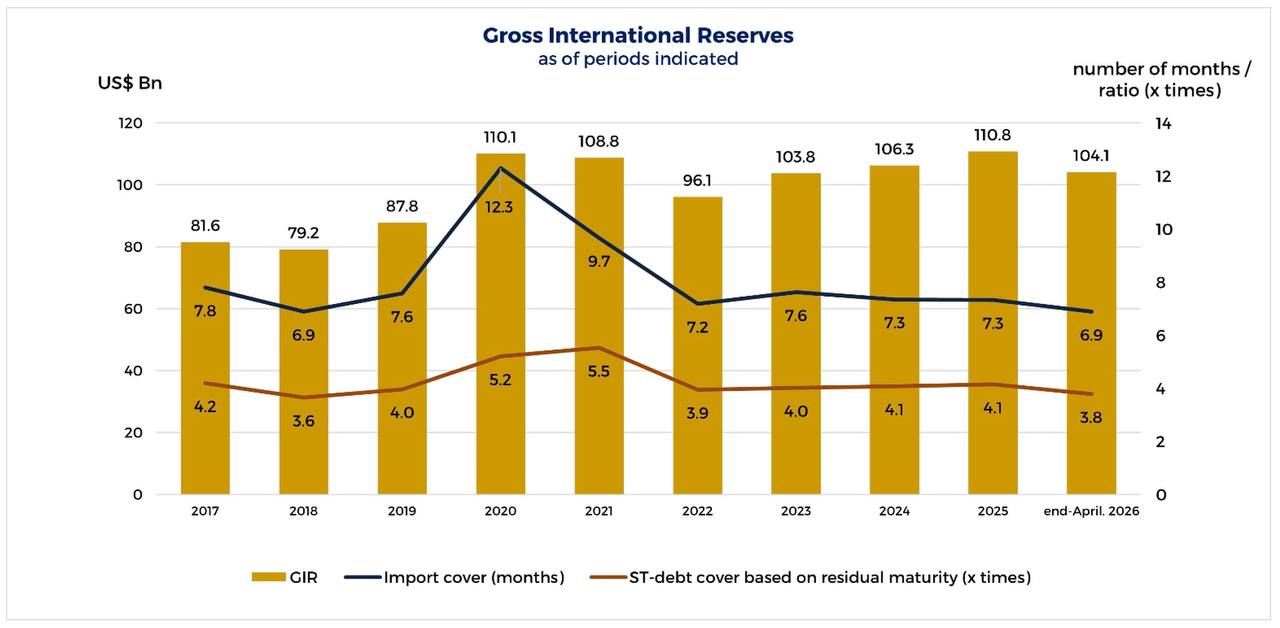
The Philippines maintained a strong external financial buffer as gross international reserves (GIR) settled at USD104.1 billion as of end-April 2026, giving the country ample protection against global market volatility, rising import costs and external debt pressures.
Preliminary data released by the Bangko Sentral ng Pilipinas (BSP) showed the reserve level could cover 6.9 months’ worth of imports of goods and payments for services and primary income, comfortably exceeding the international adequacy benchmark of at least three months.
The latest GIR position also covered about 3.8 times the country’s short-term external debt based on residual maturity, reinforcing the Philippines’ ability to meet foreign debt obligations even during periods of financial stress.
The reserve stockpile serves as one of the country’s key economic shock absorbers, helping stabilize the peso and ensuring enough dollar liquidity for imports and debt servicing amid uncertain global conditions.
Analysts said the still-robust reserve level provides a cushion as emerging economies continue to face pressure from elevated US interest rates, geopolitical tensions and volatile commodity prices that have triggered sharp swings in currencies and capital flows across the region.
The BSP’s reserve assets consist mainly of foreign-denominated securities, foreign exchange holdings, gold and other reserve assets.
Maintaining healthy reserves has become increasingly important as the Philippines navigates a widening trade deficit and fluctuating global demand, both of which can affect dollar inflows.
The GIR level is also closely monitored by investors and credit rating agencies as a measure of a country’s external stability and ability to withstand sudden economic shocks.
Even with a comfortable reserve position, a prolonged peso weakness and continued uncertainty in global financial markets could slow reserve accumulation in the months ahead.
Still, the latest figures suggest the Philippines remains in a relatively strong external liquidity position compared with many emerging market peers, giving policymakers more flexibility in managing currency volatility and external financing risks.