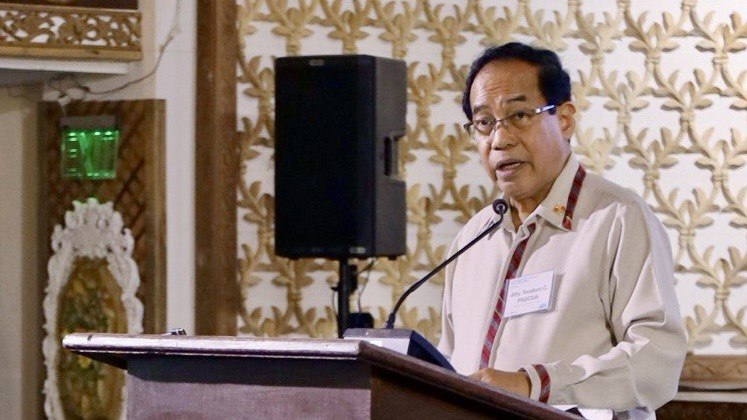
As Filipino artworks continue to command record-breaking prices, the Intellectual Property Office of the Philippines (IPOPHL) is renewing its push for stronger artists’ resale rights, arguing that creators should share in the rising value of their works long after the first sale.
Speaking at the Asian Regional Conference on Artists’ Resale Rights, IPOPHL Director General Teodoro Pascua pointed to a string of high-profile auction results that underscore the growing cultural and commercial value of Philippine art.
Among the notable sales were Félix Martínez’s “La Jota Manileña,” which fetched P39 million in December 2025; National Artist Jose Joya’s “Space Transfiguration,” sold for P112 million in 2018; Fernando Amorsolo’s “Mango Gatherers,” which reached P46 million in 2024; and “The Burning of Manila,” which sold for P36 million in 2025.
“These figures are not merely numbers. They represent the enduring cultural and economic value of Filipino creativity,” Pascua said.
The surge in art valuations, however, has revived a longstanding debate over who benefits when artworks appreciate dramatically in the secondary market. While collectors and auction houses often gain from rising prices, artists frequently receive no compensation once their works are resold.
Pascua said artists’ resale rights—commonly known by the French term “droit de suite”—help address this imbalance by allowing creators or their heirs to receive a percentage of proceeds whenever their works change hands in subsequent sales.
The issue has gained added relevance as the Philippines seeks to expand its creative economy. Pascua noted that the sector generated P2.12 trillion in 2025, equivalent to 7.6 percent of gross domestic product, supported in part by Republic Act No. 11904 or the Philippine Creative Industries Development Act.
IPOPHL Deputy Director General Ann Cabochan said resale rights were originally conceived to protect “starving artists” whose works later achieved substantial commercial success. Although the system is recognized in around 80 countries, implementation remains uneven, with major art markets such as the US and China yet to adopt it.
For IPOPHL, the challenge now extends beyond policy. Cabochan said stronger awareness and enforcement efforts are needed to ensure artists understand and can fully exercise their intellectual property rights in an increasingly valuable creative marketplace.