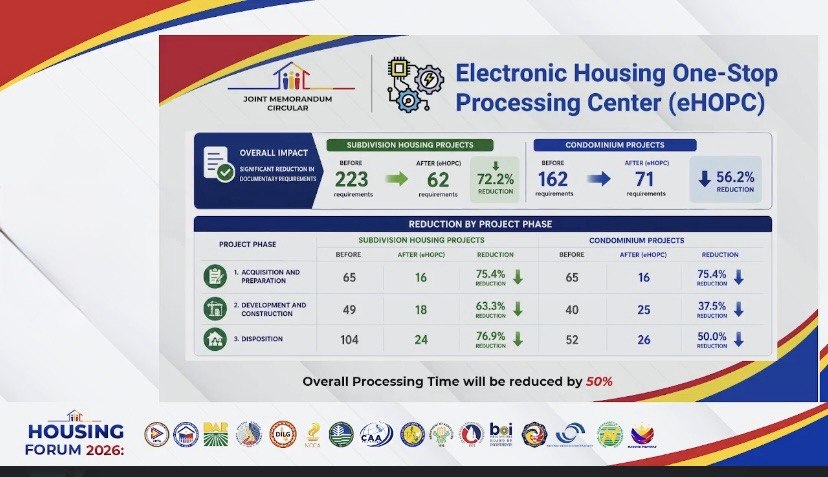
The Anti-Red Tape Authority (ARTA) and 15 government agencies have rolled out Joint Memorandum Circular No. 1, Series of 2026, introducing a unified digital permitting system designed to significantly reduce documentary requirements and processing time for housing projects as the government moves to accelerate residential construction.
The centerpiece of the reform is the Electronic Housing One-Stop Processing Center (e-HOPC), which will allow developers to submit common documents only once, with participating agencies sharing information electronically instead of requiring multiple submissions.
ARTA Director Marbida Marbida said the platform is expected to reduce documentary requirements for subdivision housing projects from 223 to 62, a 72.2 percent reduction. For condominium developments, the number of required documents will fall from 162 to 71, or by 56.2 percent.
The reforms were developed after extensive consultations with the private sector, which consistently identified overlapping regulations and lengthy permitting procedures as major impediments to housing development.
“The only way that we can really know whether there is anything we need to improve in the process is based on the feedback of the very people who interact with our regulations,” Marbida said.
He cited a 2023 study showing that developers of horizontal housing projects had to complete up to 42 procedural steps and submit 128 documentary requirements. Projects under the government’s Pambansang Pabahay para sa Pilipino (4PH) Program faced even greater complexity, requiring as many as 142 documentary requirements.
Beyond reducing paperwork, the e-HOPC is projected to cut overall processing time by about 50 percent by allowing government agencies to evaluate applications simultaneously rather than sequentially, eliminating one of the biggest sources of project delays.
The joint circular also establishes an oversight committee, institutionalizes regular public-private consultations and directs participating agencies and local government units to harmonize permitting procedures.
The reforms underscore the government’s shift from simply digitizing existing processes to redesigning them altogether. By reducing regulatory friction and improving inter-agency coordination, the administration hopes to accelerate housing construction, encourage private sector investment and help narrow the country’s estimated 6.8-million-unit housing backlog.