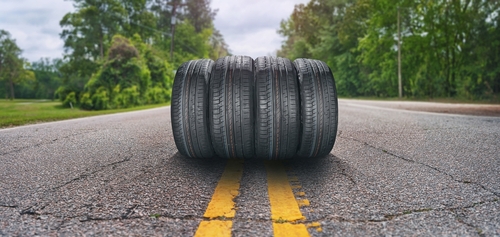
Every worn-out tire has to end up somewhere. Researchers at the University of the Philippines Los Baños (UPLB) believe one of the best places might be beneath the country’s roads.
A study published in the August issue of the Philippine Journal of Science found that finely ground waste tire rubber can make asphalt stronger, more heat-resistant and potentially longer-lasting, offering a practical way to tackle two persistent problems at once: deteriorating roads and the growing mountain of discarded tires.
The issue is hardly trivial. About 10 million tires are discarded in the Philippines every year, with most ending up in landfills, burned, or recycled into other products. The researchers argue that incorporating waste rubber into asphalt pavements could provide a more sustainable solution by turning a disposal headache into a construction material.
The timing is significant. The Philippines ranked 97th out of 140 countries in road pavement quality, underscoring the need for more durable roads that can better withstand tropical heat, heavy rainfall, and relentless traffic.
The researchers mixed finely milled waste tire rubber into bitumen, the black binder that holds asphalt together, using rubber proportions aligned with testing standards of the Department of Public Works and Highways’ Bureau of Research and Standards. The best-performing mixture contained rubber particles measuring just 0.355 millimeter, added at 14 percent of the bitumen’s weight.
Think of bitumen as the glue in a road. When that glue softens too easily, pavements become more prone to rutting, cracking and costly repairs. The rubber additive made the binder harder and raised its softening point by as much as 24 percent, helping it better resist high temperatures.
Perhaps more importantly, the modified bitumen required 51 percent more energy to break down under heat than conventional bitumen, pointing to significantly improved thermal stability.
Surprisingly, the rubber did all this without chemically altering the bitumen itself. Instead, the materials interacted through naturally occurring molecular forces, strengthening the binder while preserving its original structure.
That finding could prove just as important as the performance gains. It suggests rubber additives could offer a cost-effective way to manufacture higher-quality asphalt pavements without fundamentally changing existing production processes.
The researchers said the approach could extend pavement life, reduce maintenance costs and help improve the quality of Philippine roads, while giving millions of discarded tires each year a more productive second life beneath the wheels of tomorrow’s motorists.