Ayala Land Inc. (ALI) is seeing stronger leasing demand across its warehouse portfolio, with cold storage facilities emerging as a particularly bright spot as companies seek more temperature-controlled capacity.
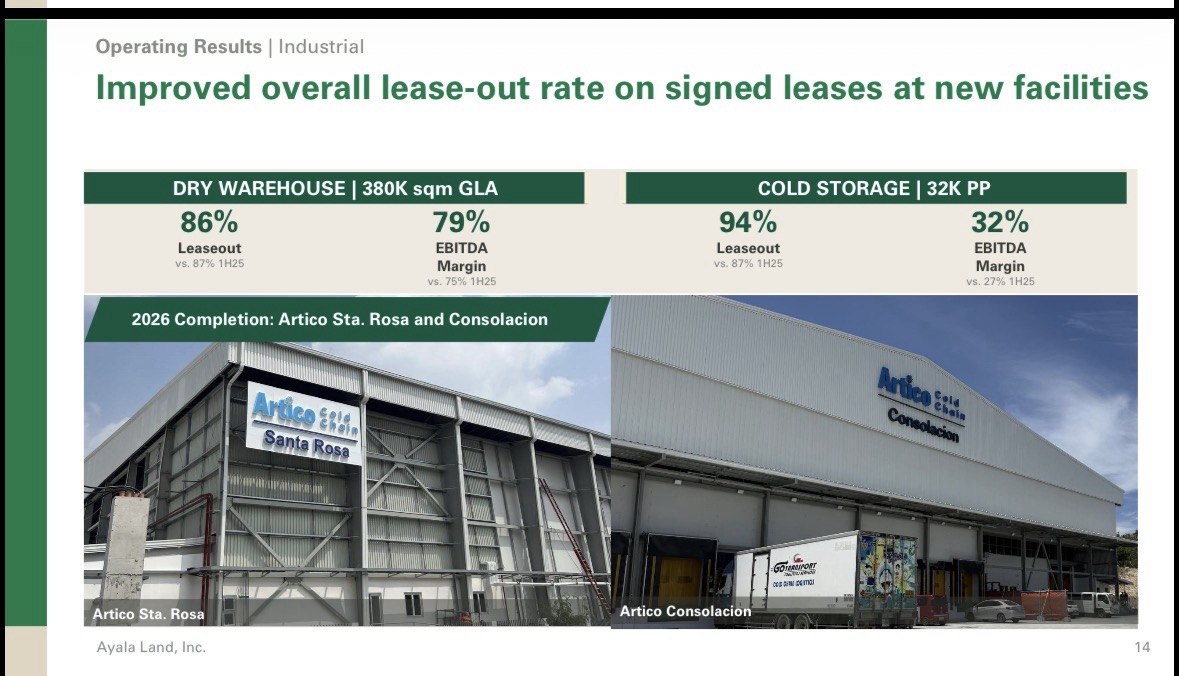
ALI Chief Financial Officer and Treasurer Jose Eduardo A. Quimpo II said lease-out rates for newly completed facilities have improved, with dry warehouses reaching 86 percent and cold storage facilities 94 percent across its 32,000 pallet positions.
The figures show sustained demand for cold storage, whose lease-out rate climbed from 75 percent in the first half of 2025. Dry warehouse leasing, meanwhile, remained broadly steady at 86 percent from 87 percent a year earlier.
“We improved overall lease-out rate on signed leases at new facilities,” Quimpo said.
The performance highlights the growing role of logistics infrastructure in supporting businesses that require reliable storage for food, pharmaceuticals, and other temperature-sensitive products.
Margins remained healthy, although the mix between dry and cold storage differed. EBITDA margins stood at 79 percent for dry warehouses and 32 percent for cold storage, compared with 87 percent and 27 percent, respectively, in the first half of 2025.
ALI’s industrial and logistics platform, ALogis, currently has about 379,600 square meters of warehouse gross leasable area, alongside 94,500 square meters of commercial GLA and 31,500 cold storage pallet positions.
The company plans to add another 9,000 cold storage pallet positions in Cebu and Laguna this year. Its Artico facilities in Santa Rosa and Consolacion are targeted for completion in 2026.
With facilities in major industrial and logistics hubs in Laguna, Cavite, and Pampanga, ALogis is positioning itself to capture demand from companies looking for strategically located and scalable warehousing capacity.
The expansion suggests that logistics real estate is becoming increasingly specialized, with cold storage gaining importance as supply chains demand more reliable infrastructure from farm, factory, and port to consumer.