
The Luzon Economic Corridor (LEC) can give investors a head start by plugging them into 218 established economic zones and 1,777 locator companies already operating along the Subic-Clark-Manila-Batangas corridor, according to the Philippine Economic Zone Authority (PEZA).
PEZA Director General Tereso Panga said the existing industrial base could shorten the time and cost needed for new investors to establish supply chains, find suppliers, recruit skilled workers, and connect to export markets.
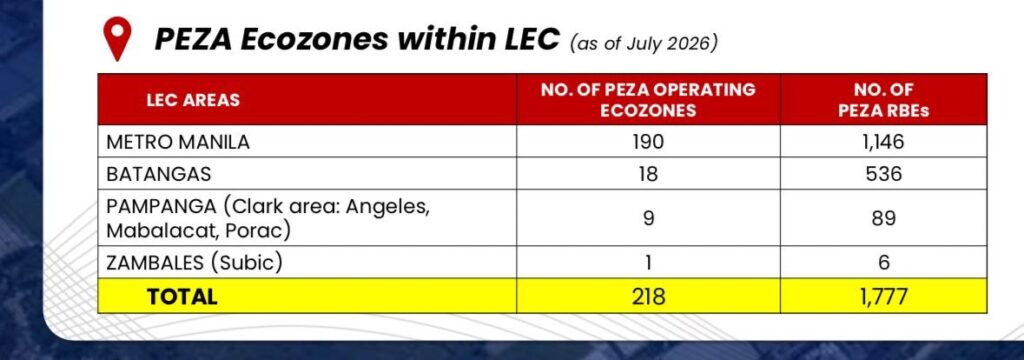
“This provides investors immediate access to mature industrial ecosystems, experienced suppliers, skilled workers, reliable utilities, and established export networks,” Panga said at the American Chamber of Commerce of the Philippines’ General Membership Meeting on Wednesday.
The corridor is being developed as an industrial investment platform linking Subic Bay, Clark, Metro Manila, and Batangas, with priority areas including semiconductors, clean energy, agribusiness, railways, ports, and other strategic supply chains.
Panga cited LIMA Estate and TARI Estate of Aboitiz, First Philippine Industrial Park, and Light Industry and Science Parks as examples of established industrial hubs that can support new investments.
“We are constantly transforming these hubs to facilitate the kind of investment we want to attract, not only within the corridor but all over the country,” Panga said.
Rather than relocate investments from existing centers, he said the LEC should connect established hubs and broaden the country’s industrial base.
“The objective is not to shift investment from established hubs, but to connect them into a stronger, more diversified Philippine industrial ecosystem,” he said.
The strategy comes as multinational companies diversify production under China+1 and Taiwan+1 strategies, creating opportunities for the Philippines to attract supply-chain investments.
Panga said the country can build on its existing strengths in electronics manufacturing, semiconductor assembly and testing, engineering, and technology services while pursuing higher-value and emerging industries.
For investors, he said the combination of infrastructure and established industrial ecosystems could help address the demand for faster, more efficient, and more seamless investment deployment.