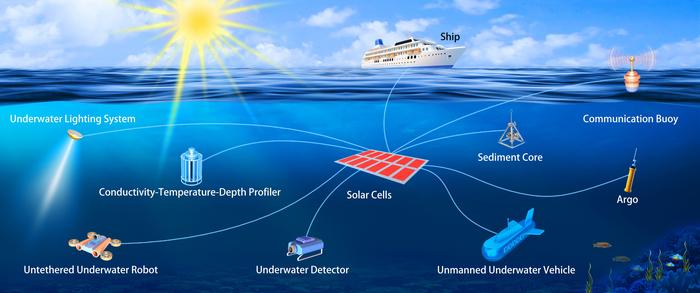
A solar panel that works underwater sounds like the sort of thing a fish might invent after getting tired of waiting for Wi-Fi. But researchers have now shown that the idea is more than a science-fiction prop.
Scientists from Yunnan University and Southwest United Graduate School have demonstrated perovskite solar cells operating 10 meters below the surface of the South China Sea, opening a possible new power source for underwater sensors, cameras, communications equipment and autonomous marine devices.
The peer-reviewed study was published September 11 in Joule.
The trick is not to make sunlight behave differently, but to make solar cells better at using the light that survives the trip underwater.
Water quickly absorbs longer wavelengths, leaving underwater sunlight increasingly dominated by blue and green light. The researchers therefore used wide-band-gap perovskites designed to match the underwater spectrum at around 10 meters.
In laboratory tests, the cells reached a power-conversion efficiency of 34.71 percent under simulated 10-meter underwater light. After 1,160 hours of simulated operation, they showed no significant degradation. Another test found the devices retained about 96 percent of their initial efficiency after 300 days in a nitrogen-filled glovebox.
Then came the part that mattered beyond the laboratory.
Large-area modules were deployed at 2, 6, and 10 meters near the Weizhou Islands. At 10 meters, two hours of sunlight produced 324 milliwatt-hours of electricity, enough to charge a lithium-ion battery and power LEDs.
The researchers’ accelerated aging tests projected a useful operating lifetime of about 5.5 years under simulated 10-meter conditions.
That does not mean underwater solar farms are about to replace offshore power cables. The technology still needs testing at greater depths and under messier real-world conditions.
But the concept could make underwater equipment less dependent on batteries, cables or frequent maintenance.
The ocean, it turns out, may have room for solar power after all.