



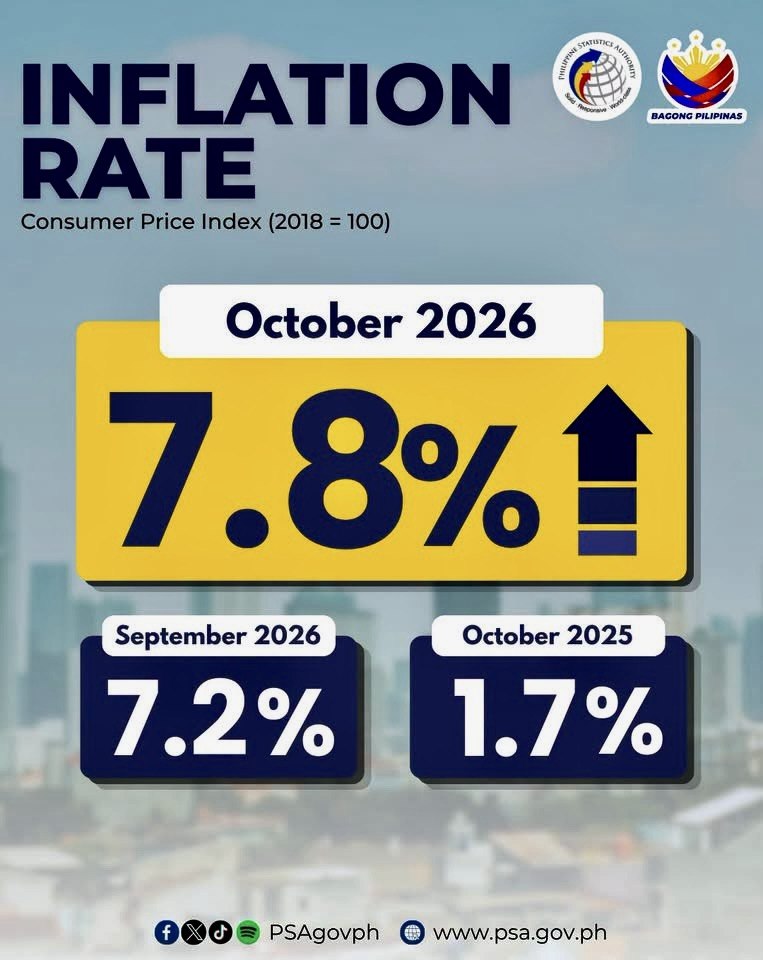
Philippine inflation accelerated to 7.8 percent in October from 7.2 percent in September, driven by sharply higher transport costs, rising housing and utility expenses, and persistent rice price increases that continued to squeeze household budgets despite some relief from slower food inflation.
The October inflation clip was the fastest since the 8.6 percent registered in February 2023.
The October reading landed near the upper end of the Bangko Sentral ng Pilipinas’ (BSP) forecast range of 7.1 to 8.1 percent, potentially keeping monetary tightening a feature of the policy landscape for an extended period even after the central bank’s recent 50-basis-point increase in overnight interest rates to 5.5 percent. Higher interest rates could eventually slow business and other economic activities.
The latest inflation print also brought the average rate for the first 10 months of 2026 to 5.6 percent, far above the 1.7 percent recorded in October last year and the BSP target range of 2 percent to 4 percent.
Transport was the biggest source of upward pressure, with prices rising 20.1 percent year-on-year, faster than September’s 14.6 percent. Housing, water, electricity, gas and other fuels also accelerated to 9.3 percent from 8.4 percent, adding to the cost of maintaining a household.
Core inflation, which strips out selected volatile food and energy items to show underlying price pressures, likewise climbed to 5.4 percent from 4.8 percent, suggesting that inflationary pressures were spreading beyond fuel and food.
Inflation for the bottom 30% income households increased to 9.5 percent in October 2026 from 9.0 percent in September 2026. This brings the average inflation rate from January to October 2026 to 6.8 percent.
Food inflation, meanwhile, eased to 6.4 percent from 6.8 percent in September, helped by slower price increases for fish and vegetables. However, the relief was uneven.
Rice inflation accelerated to 20.7 percent from 20.3 percent, while corn prices rose 19.3 percent from 17.3 percent. Fruit prices also climbed faster, increasing 10.8 percent from 8.7 percent.
Cereals and cereal products, including rice, accounted for 72.5 percent of food inflation, underscoring how staple goods continued to drive grocery bills higher.
Restaurants and accommodation services also saw inflation accelerate to 7.7 percent from 7 percent.
In Metro Manila, inflation rose to 5.9 percent from 5.3 percent, driven largely by faster increases in transport and housing-related costs, although food inflation eased to 4 percent from 4.8 percent.
The figures highlight the uneven nature of price pressures, with slower food inflation offering limited relief as transport, utilities, and essential household expenses continue to become more expensive.




