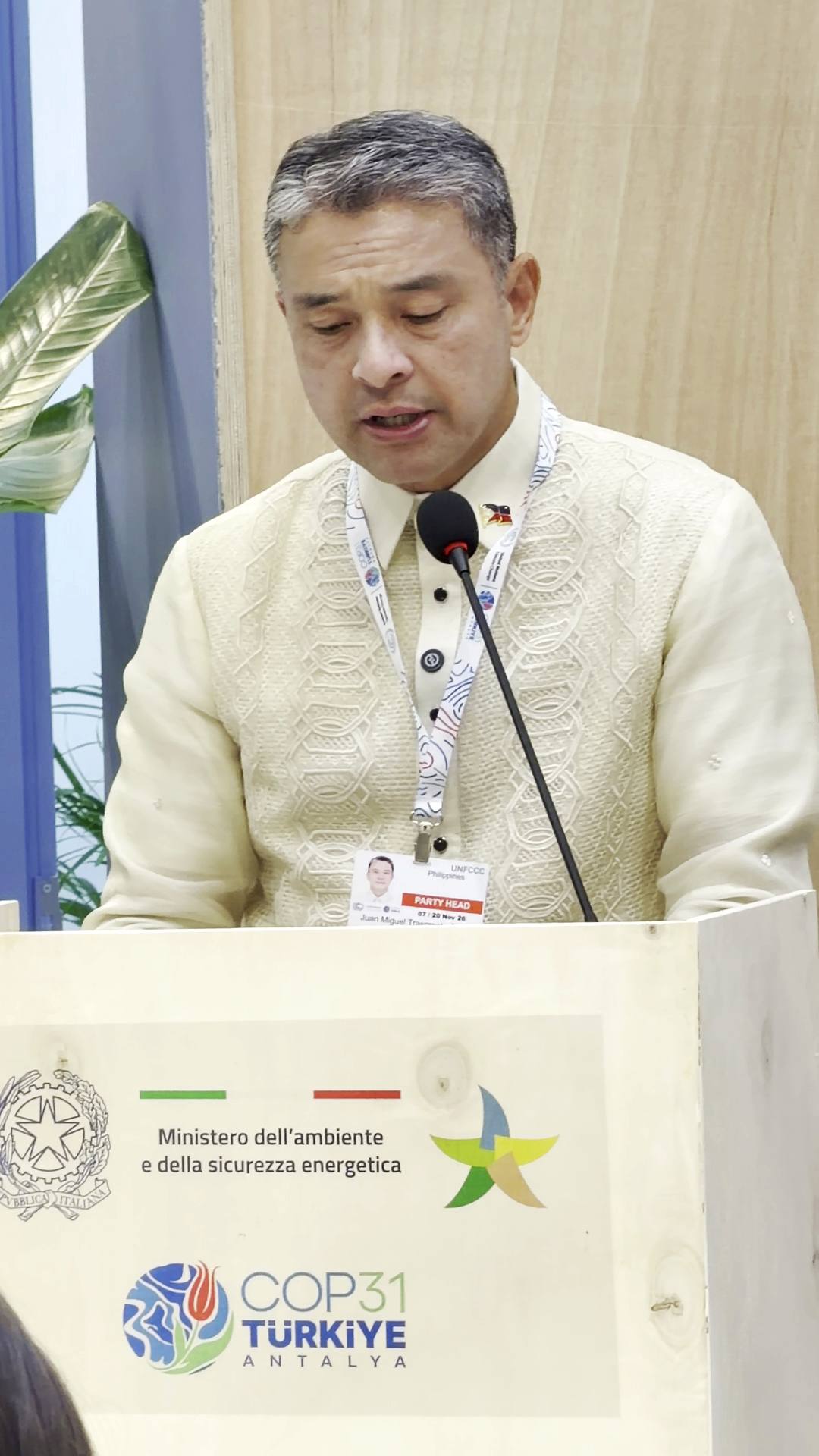
Environment Secretary Juan Miguel T. Cuna called Monday in Turkiye for urgent, constructive reforms to the world’s financial systems, saying bold climate action means nothing if developing nations cannot access the trillions of dollars they need to adapt and grow resilient. He issued the appeal in his keynote address opening Italy’s Pavilion at the 31st United Nations Climate Change Conference (COP31) here.
Speaking before ministers, global climate leaders, and financiers, Cuna stressed that developing countries remain locked out of the resources required to tackle rising climate risks. “Developing countries continue to face enormous hurdles in securing the trillions in climate finance required for mitigation and adaptation,” he said. “Raising global ambition is meaningless without creating the financial architecture to deliver it.”
The event was organized by Italy’s Ministry of Environment together with sustainability platform illuminem, launching a series of high-level discussions held in the COP31 Blue Zone. Cuna thanked Italy for its longstanding partnership with the Philippines on environmental cooperation and urged all participants to turn pledges into real, usable financial support and decisive global action.
He laid out three pressing realities facing the world: the growing likelihood of breaching the critical 1.5°C warming limit, ongoing instability in global energy markets, and the persistent shortfall in funding for the nations most vulnerable to climate harm. “Science warns us that we are approaching or temporarily exceeding the 1.5°C warming threshold,” Cuna said. “For archipelagic nations like the Philippines and our neighbors across Southeast Asia, an overshoot is not a statistical anomaly. It manifests as severe storm surges, rapid biodiversity loss, and immediate threats to coastal economies, agricultural security, and human lives.”
As the current Chair of the Association of Southeast Asian Nations, the Philippines is pushing for stronger regional cooperation to speed up clean energy rollout, boost climate resilience, and base policies on sound scientific data. Cuna highlighted the need for open, reliable climate information, wider access to funding for loss and damage, and greater private-sector investment to help shift economies toward low-carbon, climate-resilient growth.
He welcomed the recent start-up of the United Nations Fund for Responding to Loss and Damage but stressed it must deliver money when and where it is needed most. He also called for clearer rules and frameworks that would unlock private capital for renewable energy, stronger infrastructure, and more sustainable supply chains.
“The true measure of COP31 will not be judged by the statements we deliver, but by the tangible protection and resilience we secure for our people and our planet,” Cuna said in closing. The gathering also opened new avenues for practical cooperation between the Philippines, Italy, international bodies, and business leaders on shared climate and development goals.