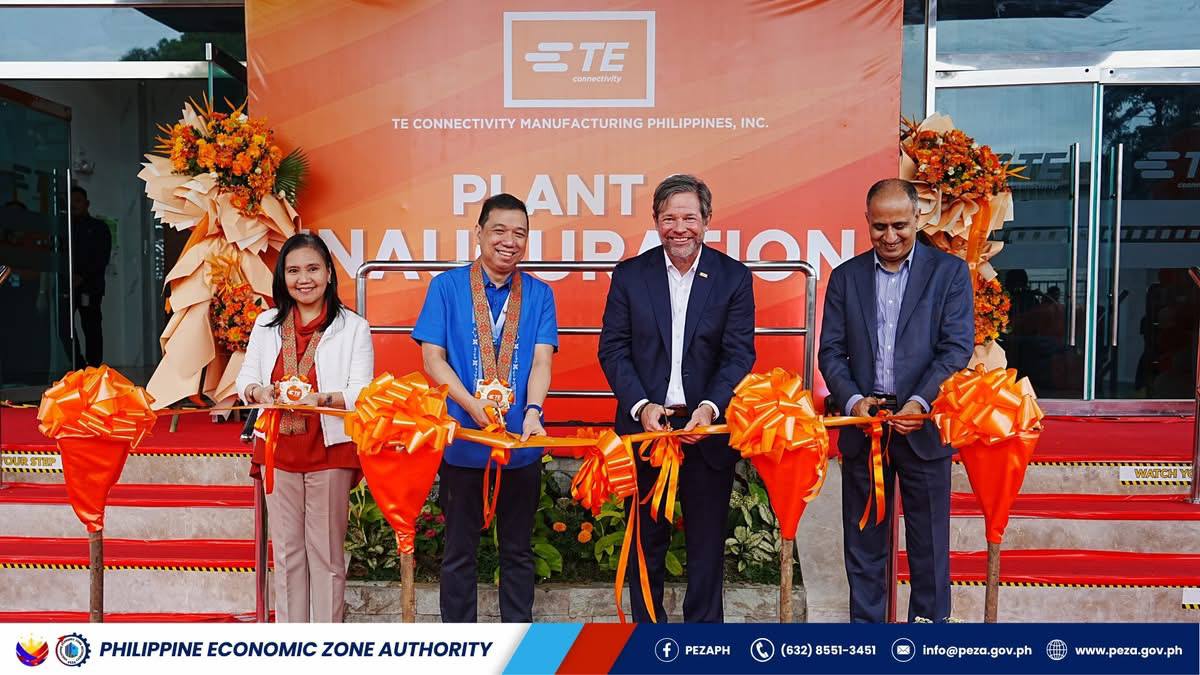
TE Connectivity Manufacturing Philippines, Inc. is doubling down on the country, committing P4 billion to expand its Batangas operations and signal a long-term bet on the Philippines as a high-tech production and innovation hub.
The global technology firm inaugurated on January 6 its new Plant 2 facility inside the First Philippine Industrial Park–Special Economic Zone (FPIP-SEZ) in Sto. Tomas, Batangas, adding fresh capacity for advanced manufacturing as global demand for digital infrastructure accelerates.
The facility will focus on the development, research, and manufacturing of electronic connectors and interconnection devices—small but mission-critical components that power data centers, vehicles, aircraft, factory automation, and life-saving medical equipment.
Beyond bricks and machines, the expansion brings jobs.
TE Connectivity expects to hire around 600 additional workers, lifting its local headcount to roughly 1,100 employees and creating more opportunities for skilled engineers, technicians, and production specialists in South Luzon.
Company executives said the investment reflects confidence in the Philippines’ talent pool, operating environment, and ability to support higher-value manufacturing and R&D work. It also reinforces FPIP’s growing reputation as a destination for technology-driven exporters seeking scale, reliability, and proximity to Asian markets.
TE Connectivity Manufacturing Philippines, Inc. is the local arm of US-based TE Connectivity, a global supplier of connectors, sensors, and wiring solutions serving automotive, aerospace, data, industrial, and medical customers worldwide.
With Plant 2 online, the company is positioning the Philippines not just as a factory floor, but as a critical node in its global innovation network.
Industry observers say the move aligns with government efforts to climb the value chain, attract resilient investments, and embed the country deeper into global supply chains amid shifting geopolitical and trade dynamics across Asia-Pacific manufacturing ecosystems today.