Deep inside a tuna’s body lies a microscopic world that could help scientists—and fishers—better understand how these fast-swimming fish reproduce and survive in busy tropical seas.
A new study in the Philippine Journal of Science examined the reproductive biology of three commercially important tuna species commonly caught in Philippine waters: the kawakawa, the frigate tuna, and the bullet tuna.
The research was led by John Christian D. Entia of Ghent University, together with Niña Mae B. Nabre of Mindanao State University and Red Arthur Duke A. Amoncio from the Bureau of Fisheries and Aquatic Resources.
Their goal is to zoom in on how male tuna develop sperm.
To do this, scientists examined 1,009 tuna collected from fishing grounds in the southern Philippines between April 2021 and March 2022. The fish came from areas such as Sarangani Bay, Davao Gulf, Moro Gulf, and the Celebes Sea. Samples were analyzed at the Regional Science Research Center of Mindanao State University in General Santos City.
Under the microscope, researchers used a classic laboratory technique called hematoxylin and eosin staining. The stain colors different cell structures, allowing scientists to track the stages of sperm development.
What they saw was a clear, repeating cycle.
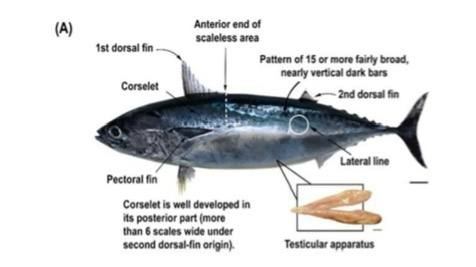
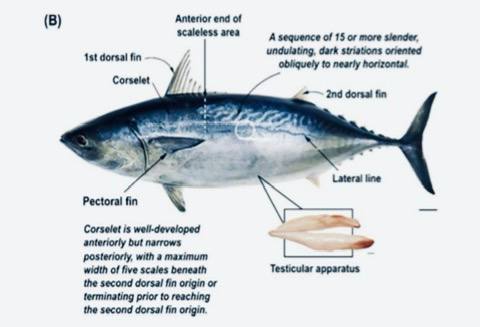
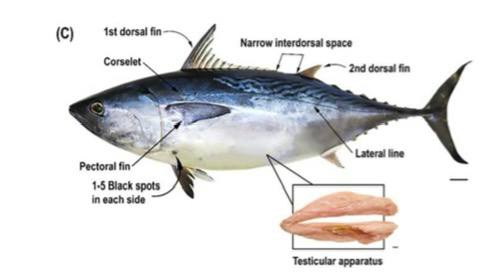
Male tuna pass through six reproductive phases: immature, onset maturation, developing, spawning, spent, and recovering. Early on, the testes show only basic regions. As the fish matures, structures like lobules and tubules begin forming, producing sperm cells step by step. Eventually the spawning phase appears—when mature sperm fill the ducts and the fish is ready to reproduce.
After spawning, the testes enter a “spent” stage with leftover cells before shifting into a recovery period where new sperm production begins again.
Surprisingly, all three tuna species followed almost the exact same pattern.
That similarity could be good news for fisheries managers. If the species mature and spawn in similar cycles, rules such as seasonal fishing closures or protection of spawning grounds might work for all three species at once.
For a country like the Philippines—where tuna fishing supports thousands of livelihoods—understanding these tiny reproductive details could help protect big ocean resources.
Next, the researchers hope to dig even deeper, using molecular tools and powerful electron microscopes to uncover subtle differences hidden beyond what the light microscope can see.