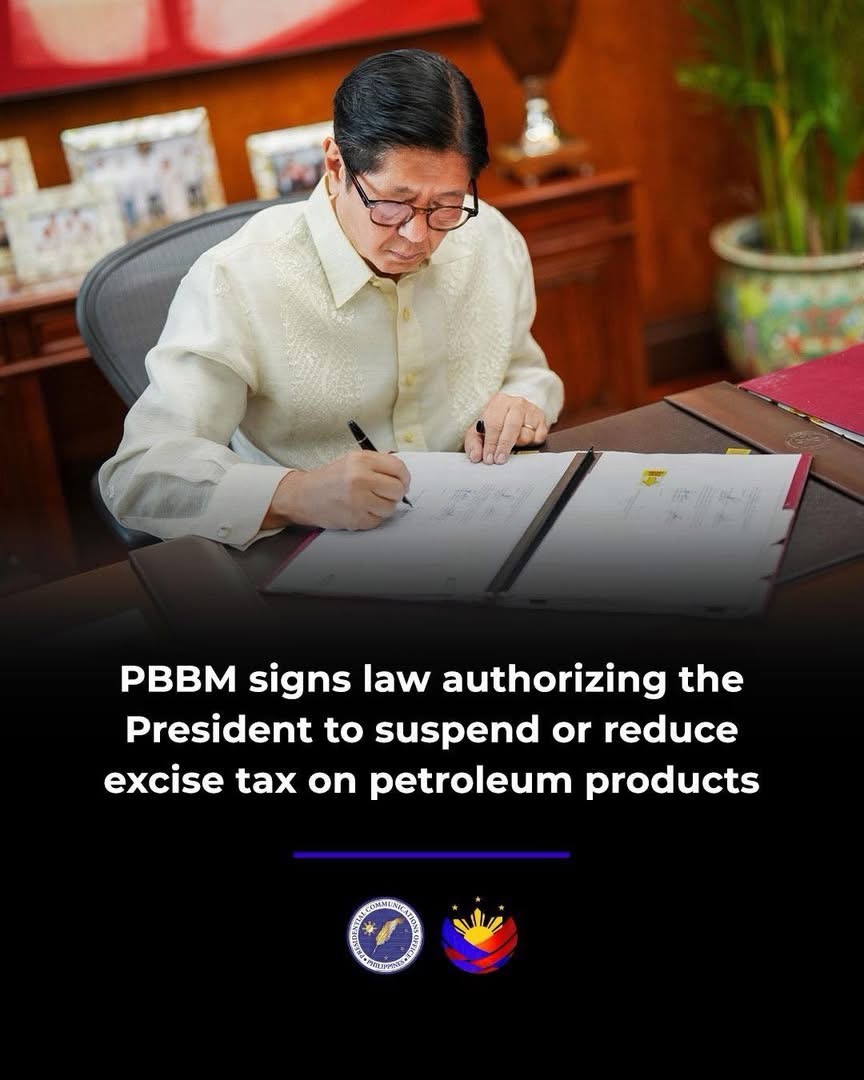
President Ferdinand Marcos Jr. on Wednesday signed into law Republic Act No. 12316, a measure granting him the authority to suspend or reduce excise taxes on petroleum products in response to surging global oil prices.
The new law amends Section 148 of the National Internal Revenue Code of 1997, enabling swift government intervention when crude oil prices spike.
Specifically, the President may act once the average Dubai crude oil price, based on the Mean of Platts Singapore (MOPS), reaches or exceeds USD80 per barrel for at least one month. That level has been breached last week, according to the Department of Energy.
Malacañang said the measure aims to cushion Filipino consumers from the economic impact of rising fuel costs, particularly amid heightened geopolitical tensions in the Middle East that have disrupted global supply and driven prices upward.
Under the law, the President may implement either a full suspension or partial reduction of excise taxes on selected petroleum products, depending on prevailing economic conditions.
The relief, however, is time-bound and may not exceed three months, after which the original tax rates will automatically be reinstated unless extended by further action.
The measure also strengthens oversight and transparency. The Development Budget Coordination Committee (DBCC), in coordination with the Department of Energy (DOE), is required to submit a report to Congress detailing the rationale, fiscal impact, and broader economic effects of any tax adjustment. This includes analysis of inflation, household impacts, and potential market distortions.
Oil companies will likewise be mandated to provide monthly breakdowns of fuel pricing components, while revenue agencies must report on tax collections.
Economic managers view the law as a flexible tool to stabilize prices without permanently reducing government revenues, balancing consumer protection with fiscal sustainability.