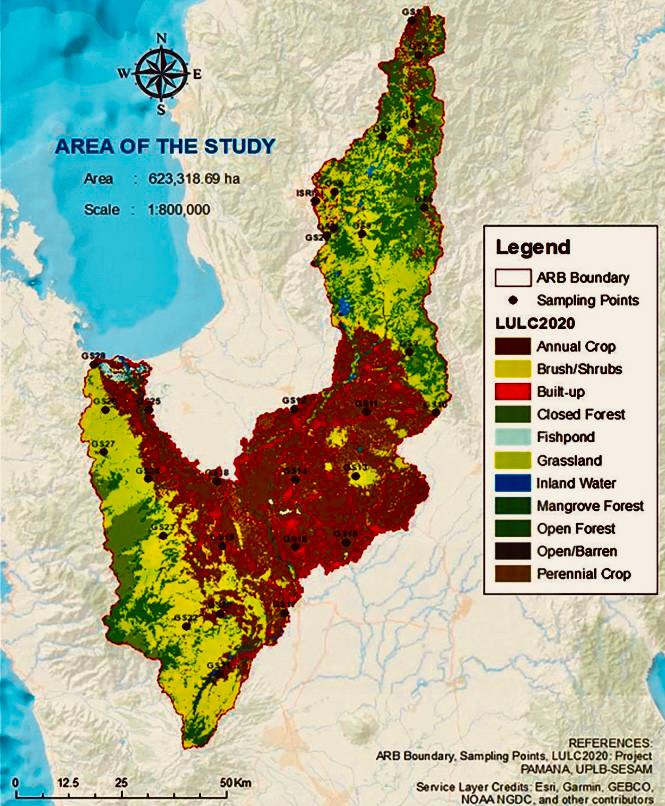
In the Agno River Basin, climate science is not just about storms and emissions reports. It is also happening silently underground, where soil keeps a running account of how land use decisions affect carbon storage.
A study led by the Department of Environment and Natural Resources, and published in the April Philippine Journal of Science effectively turns the basin’s soil into a climate balance sheet. The research showed that forests store the most soil organic carbon, followed by grasslands, then agricultural land, with built-up areas consistently at the bottom.
The gaps are not subtle, and they hold up under significance testing, suggesting land cover is not just a backdrop but a driver of carbon storage.
Across the basin, soil organic carbon ranges from 0.11 percent to 4.39 percent, but the real story is the pattern. Forest soils act like well-stocked carbon vaults, especially in the top 20 centimeters where biological activity is highest.
Across all land types, topsoil consistently outperforms deeper layers, confirming that most of the action is happening close to the surface.
The storage figures reinforce the hierarchy. Forests lead in tons of carbon per hectare, followed by grasslands and agriculture, with built-up areas trailing sharply behind.
Basin-wide stocks average 61.82 tons per hectare, but vary widely depending on what sits above the soil.
The logic is almost commonsense once translated from lab data to landscape behavior. Forests continuously feed soil with leaf litter and roots, topping up carbon reserves. Concrete and heavily altered land, by contrast, cuts off that input stream, leaving soil gradually depleted.
Soil chemistry adds texture but not dominance to the story.
Denser soils and higher pH tend to align with lower carbon, while clay offers a modest helping hand in retention. But correlations remain weak, pointing back to vegetation as the main control knob.
In effect, the study reframes soil as more than dirt. It is a slow-moving climate ledger, and in river basins like Agno, what is built, planted, or cleared above ground quietly decides what the earth keeps in reserve below it.