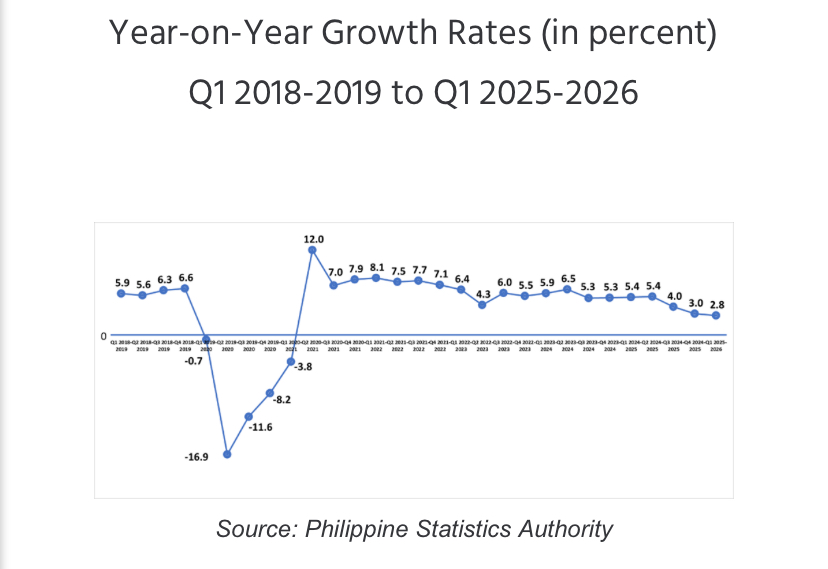
The economy grew by 2.8 percent in the first quarter of 2026, slowing from 3 percent in the previous quarter and falling short of the government’s expectations of 3.5 percent growth, according to official data.
The weaker performance, the Philippine Statistical Office said Thursday, marked the country’s slowest economic expansion since the pandemic-era contraction in early 2021, highlighting growing pressure on households and businesses as rising global oil prices and domestic political issues weighed on economic activity.
The slowdown means many Filipino families likely faced tighter budgets during the quarter, as higher fuel and transport costs reduced spending power. Consumer spending, a major driver of the economy, grew at a slower 3 percent pace compared with 3.8 percent in the previous quarter, suggesting households became more cautious with purchases.
Businesses also remained under pressure, with private investment contracting for a second straight quarter. Fixed investment fell by 2.7 percent, although this was an improvement from the steeper 6.4 percent decline previously recorded. Analysts said uncertainty linked to a major infrastructure corruption scandal, combined with higher operating costs from the Middle East war-driven oil shock, dampened business confidence and delayed expansion plans.
Government spending provided some support to the economy, accelerating to 4.8 percent growth from just 0.7 percent in the fourth quarter. Trade also helped cushion the slowdown, as exports rose 7.8 percent, while imports grew at a slower pace of 6.1 percent.
On the production side, agriculture, forestry and fishing contracted by 0.2 percent, reversing the previous quarter’s growth, while industrial activity also slipped by 0.1 percent. The services sector, which includes retail, transport and tourism, continued to expand but at a slower 4.5 percent pace.
The latest figures placed the economy well below the government’s full-year growth target of 5 percent to 6 percent, raising concerns about whether the Philippines can regain stronger momentum in the coming quarters.
Economists said the outlook will depend largely on global oil prices, inflation trends and whether investor confidence improves after the recent political controversy. Continued government spending and stable export demand could help support growth, but persistent high costs and weak private investment may continue to limit recovery in the near term.