Motorists will soon have a clearer way to compare the fuel efficiency of vehicles across brands as the government prepares to fully enforce a mandatory fuel economy labeling program aimed at standardizing vehicle performance information, according to the Department of Energy (DOE).
Patrick Aquino, director of the DOE’s Energy Utilization Management Bureau, said the Fuel Economy Performance Rating System will help consumers make more informed purchasing decisions by providing a uniform measure of vehicle efficiency.
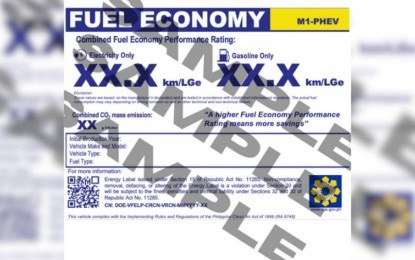
Under the program, all new vehicles sold in the Philippines must carry a fuel economy label—the blue-and-yellow sticker already appearing on models from brands such as Toyota, MG, and Isuzu. The label shows a vehicle’s fuel economy performance using a standardized kilometer-per-liter gasoline equivalent rating, enabling buyers to directly compare conventional, hybrid, and electric vehicles.
Aquino said the labeling requirement is already in place, but stricter enforcement will begin in 2027, when regulators start checking compliance. Penalties for manufacturers that fail to display the labels are expected to be imposed beginning in 2028.
The initiative is designed to eliminate varying fuel-efficiency claims by requiring automakers to use a common calculation method. This will allow consumers to make “apples-to-apples” comparisons across different vehicle types, whether evaluating an electric vehicle such as a Tesla or a gasoline-powered model from Toyota or Isuzu.
Vehicles with higher ratings can travel farther using the equivalent amount of energy, making them more efficient and potentially less expensive to operate.
The fuel economy labeling program is part of broader government efforts to improve transparency in the automotive market, promote energy-efficient transportation, and support the country’s energy security and sustainability goals.
By giving consumers clearer and more comparable information, the DOE hopes the system will also encourage manufacturers to continuously improve vehicle efficiency and accelerate the shift toward cleaner mobility.