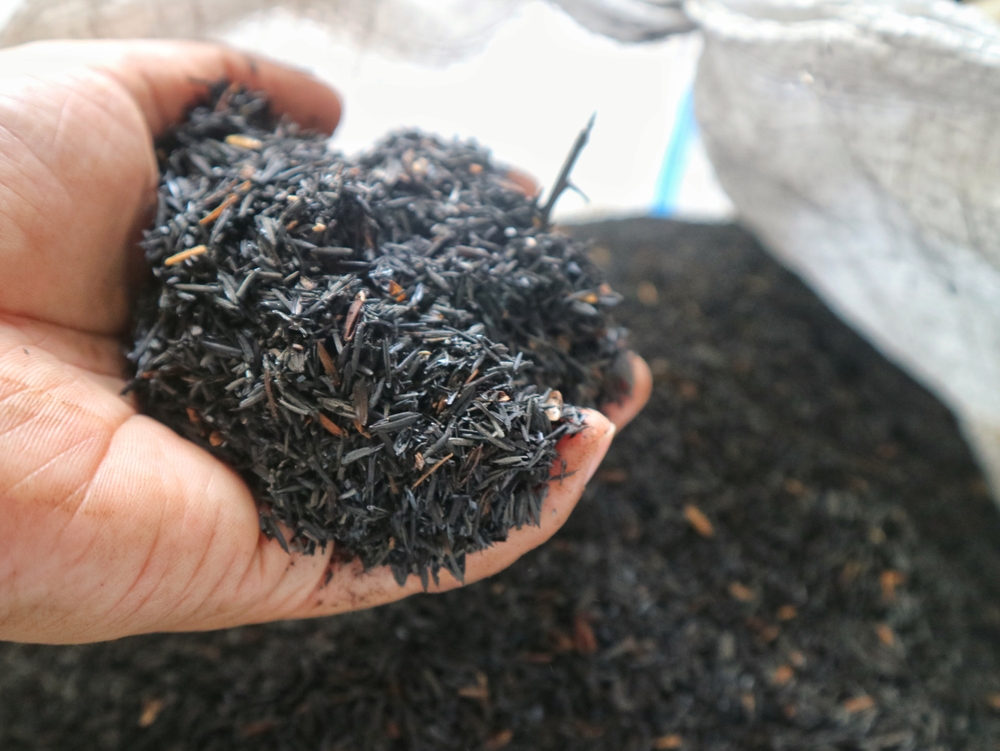
Rice husks have long been treated as agriculture’s equivalent of an unwanted houseguest. After the rice is harvested and milled, the husks are often discarded, burned, or left to pile up.
But what if those discarded rice husks had bigger ambitions—not to become fertilizer, animal feed, or fuel, but to help power the smart fabrics of the future?
That is precisely the possibility explored in a study published in the June issue of the Philippine Journal of Science.
As the world races to develop “smart textiles”—fabrics capable of conducting electricity for sensors, health monitors, and wearable electronics—researchers are searching for materials that are not only functional but also sustainable. After all, a smart shirt is even smarter if it doesn’t leave a large environmental footprint.
Researchers Paul Jhon G. Eugenio and Christina A. Binag of the University of Santo Tomas took an inventive route. They transformed rice husks into biochar, a carbon-rich material similar to charcoal, and combined it with zinc oxide and a conductive polymer called polyaniline. The resulting mixture was then applied to fabric woven from two fibers Filipinos know well: abaca and cotton.
The result was a fabric capable of conducting electricity—a key requirement for wearable electronics and next-generation sensors.
But as with many successful recipes, balance proved crucial.
The researchers discovered that adding a modest amount of zinc oxide dramatically improved conductivity, making the fabric more than 15 times better at carrying electrical current than versions without it. Yet when additional zinc oxide was added, performance began to decline. Instead of helping electricity move, excess zinc oxide became a traffic jam on the information highway. In scientific terms, too much of a good thing became exactly that—too much.
The findings are especially promising because zinc oxide brings more to the table than conductivity. It is also known for antimicrobial and ultraviolet-protection properties, raising the possibility of fabrics that are not only smart but also cleaner, safer, and more durable.
The study demonstrates how agricultural waste can be transformed into high-value materials for future technologies. If further research confirms the fabric’s durability and washability, the lowly rice husk may someday enjoy one of the most remarkable career changes in agriculture—from discarded farm byproduct to a key ingredient in wearable technology.
Not bad for something most people throw away.