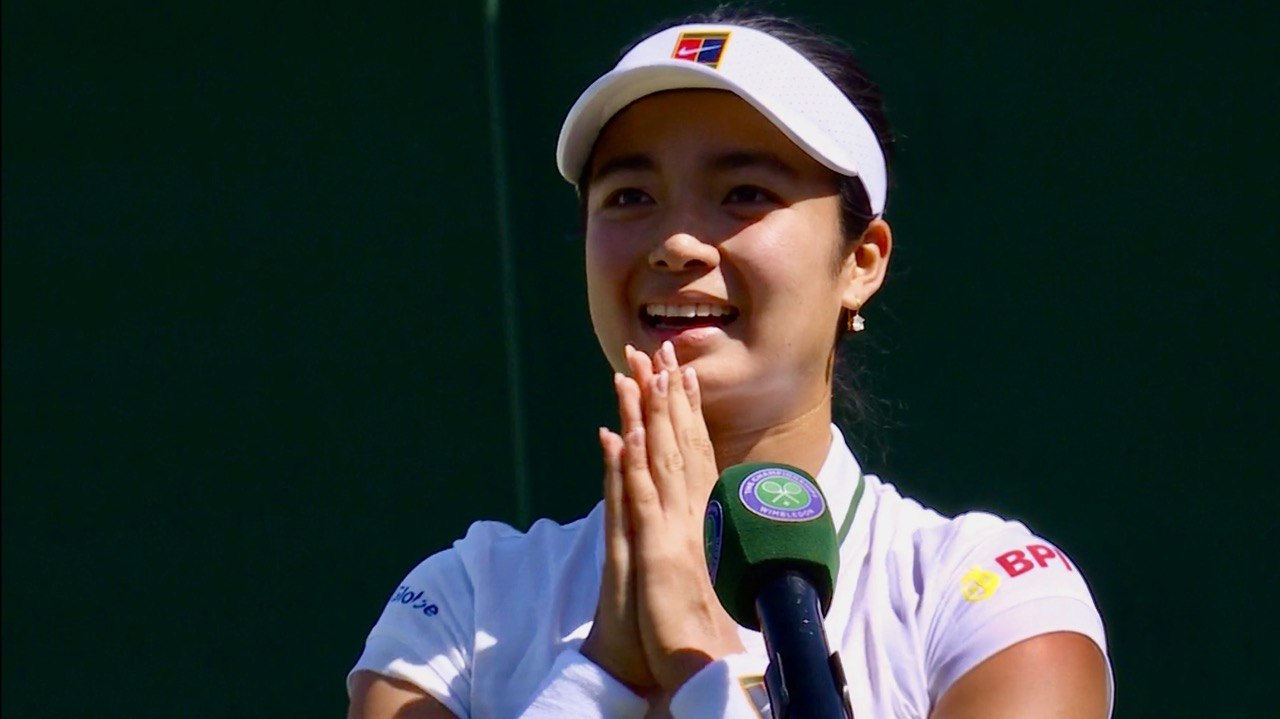
Grass, it turns out, suits Alex Eala just fine.
The Filipina rising star shrugged off a ragged opening set before turning Centre Court’s fast surface into her ally, blasting past Australia’s Maya Joint, 3-6, 6-2, 6-0, to reach the third round of Wimbledon for the first time—and, in the process, record the deepest Grand Slam run of her young career.
The victory also carried a measure of revenge. Joint had beaten Eala at last year’s Eastbourne Open, but on Thursday the script flipped dramatically as the 21-year-old Filipino left-hander found her rhythm and never looked back.
After dropping the first set, Eala’s serve suddenly became a weapon instead of a liability. She peppered Joint with four aces, repeatedly earned free points on first serve, and dictated rallies from the baseline, forcing the Australian into increasingly risky shots.
The shift was striking. Joint broke Eala twice in the opening set, but once Eala settled in, the Australian barely found breathing room. By the deciding set, rallies had become a battle of patience—and one Joint consistently lost, committing error after error as Eala raced to a 6-0 “bagel.”
Joint exits Wimbledon with a prize payout of around USD168,000 and a win over comebacking Serena Williams, a 23-time singles Grand Slam winner, including 7 championships in Wimbledon.
Statistics told the story of two very different matches. Eala struck 16 winners, matched them with just 16 unforced errors, and converted five of 19 break-point opportunities. Joint, despite producing 32 winners, also committed 32 errors, illustrating how quickly aggression can unravel on Wimbledon’s slick grass.
The reward extends beyond another day in London. The win is projected to lift Eala from No. 32 to at least No. 27 in the WTA rankings, another milestone in a season already filled with breakthroughs. To date, her highest WTA ranking was 29.
“I really had to dig deep, especially after that first set. Maya came out on fire—she was ready,” Eala said in her post-match interview. “She was obviously coming off an amazing win. I watched that match, and she played really well and handled herself really well in that situation….Knowing that, I knew I had to dig deep.”
Eala also reflected on her loss to Joint at last year’s Eastbourne Open, admitting it had been a painful defeat but one that ultimately fueled her progress.
That loss “hit me quite hard and I cried a lot. And I don’t think I was able to watch those highlights for a couple of months,” she said. “I think I improved a lot in this past year, and I’m happy that I’m able to look back at that loss and I’m able to smile.”
Eala said her win was a birthday gift of sorts for her coach Joan Bosch from the Rafael Nadal Academy.
The challenge at Wimbledon now becomes significantly steeper.
Awaiting Eala is world No. 6 and six-time Grand Slam winner Iga Świątek, with whom she shares a surprisingly even rivalry. Eala stunned the Polish star in straight sets on the hard courts of Miami before Świątek returned the favor on Madrid’s clay.
Now comes the rubber match—on Wimbledon grass, where Swiatek rules as defending champion. There is no harsher proving ground than challenging the queen on her own throne. But every great upset begins the same way: with someone daring to walk into the fire, trusting it will forge rather than consume her.