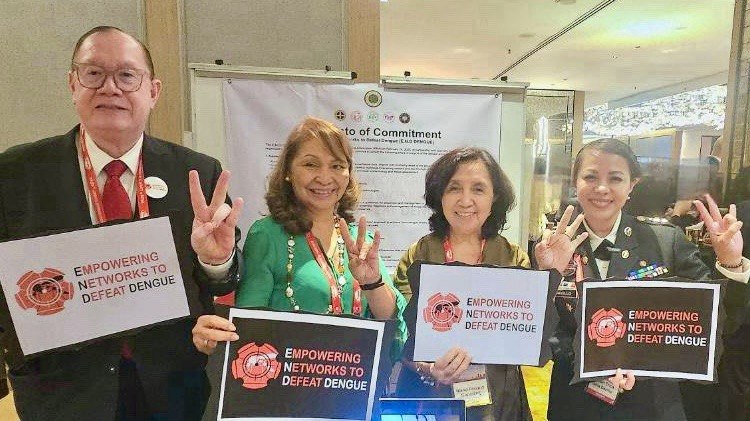
Dengue does not stop at national borders, and neither should the fight against it. That was the message as the Philippines joined Southeast Asian health leaders in renewing regional cooperation against one of the region’s most stubborn public health threats.
At the Asia Dengue Summit in Singapore, held alongside ASEAN Dengue Day 2026, scientists, policymakers, and advocacy groups from across the region gathered to sharpen strategies against dengue and other Aedes-borne diseases. The meeting brought together experts from the Philippines, Malaysia, Indonesia, Singapore, Thailand, Vietnam, and other partner countries to align research, policies, and disease-control efforts.
Representing the Philippines were infectious disease experts Dr. Rose Capeding and Dr. Lulu Bravo, who highlighted the country’s growing role in dengue research, scientific collaboration, and public health advocacy.
A major outcome of the summit was a regional memorandum of understanding signed by advocacy organizations from the Philippines, Singapore, Malaysia, and Indonesia, creating a stronger framework for joint research, policy advocacy, public education, and cross-border cooperation.
The Philippines also showcased its multi-sector approach, where medical societies, academic institutions, media organizations, and public health groups work together to improve disease awareness and community engagement—a model increasingly viewed as essential as outbreaks become more complex.
Scientific discussions went beyond mosquito control. Experts examined new biomarkers that could help detect severe dengue earlier, the long-term health effects of infection, obesity-related risks, advances in real-time patient monitoring, and emerging threats such as chikungunya.
The summit underscored a growing reality: climate change, urbanization, and increased travel are making mosquito-borne diseases harder to contain within national boundaries. For the Philippines, strengthening regional scientific partnerships is no longer simply good diplomacy—it is becoming a public health necessity. In the battle against dengue, shared knowledge may prove just as valuable as new medicines or mosquito control measures.