The Philippine economy is proving that some of its biggest opportunities are no longer on land.
The country’s ocean economy expanded to P1.08 trillion in 2025, growing 5.3 percent from P1.02 trillion a year earlier, as stronger shipping, marine services and fisheries underscored the growing value of the nation’s vast coastline and surrounding waters.
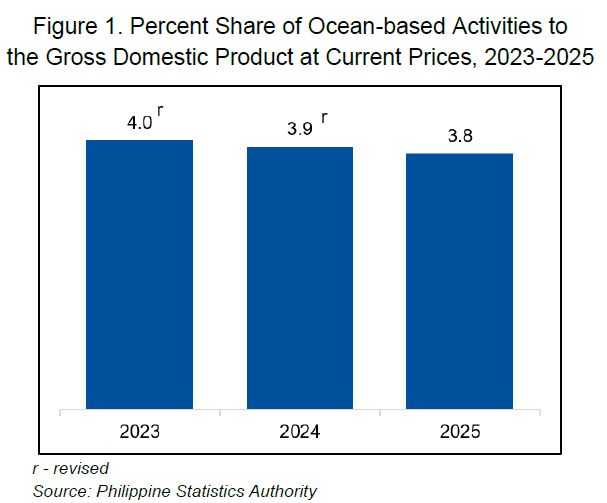
Data from the Philippine Statistics Authority showed ocean-based industries accounted for 3.8 percent of the country’s gross domestic product last year, reinforcing the sector’s increasingly important role in driving growth and employment.
The fastest-growing segment wasn’t fishing or tourism—it was marine safety, surveillance and resource management, which surged 32 percent. Marine insurance followed with 30 percent growth, while sea-based transportation and storage rose 11 percent, reflecting rising maritime activity and greater investment in protecting and moving goods across Philippine waters.
The figures suggest the ocean economy is becoming more sophisticated. Beyond harvesting marine resources, more value is now being created through logistics, risk management and maritime services that support trade.
Fishing, however, remains the industry’s biggest anchor.
Ocean fishing contributed 24 percent of the sector’s total value, followed by the manufacture of ocean-based products at 21 percent. Sea-based transportation and storage accounted for 16 percent, while coastal accommodation and food and beverage services made up 12 percent, highlighting the continued importance of tourism to coastal communities.
The sector is also creating jobs.
About 2.46 million Filipinos worked in ocean-based industries in 2025, up 3.4 percent from 2.38 million the previous year. That means one in every 20 employed Filipinos now earns a living from the country’s marine economy.
Ocean fishing remained the largest employer, accounting for 38 percent of ocean-based jobs, followed by sea-based transportation and storage at 24 percent and coastal accommodation and food services at 22 percent.
For an archipelago of more than 7,600 islands, the latest figures offer a timely reminder: the Philippines’ blue economy is no longer just a natural advantage. It is steadily becoming a larger economic engine.