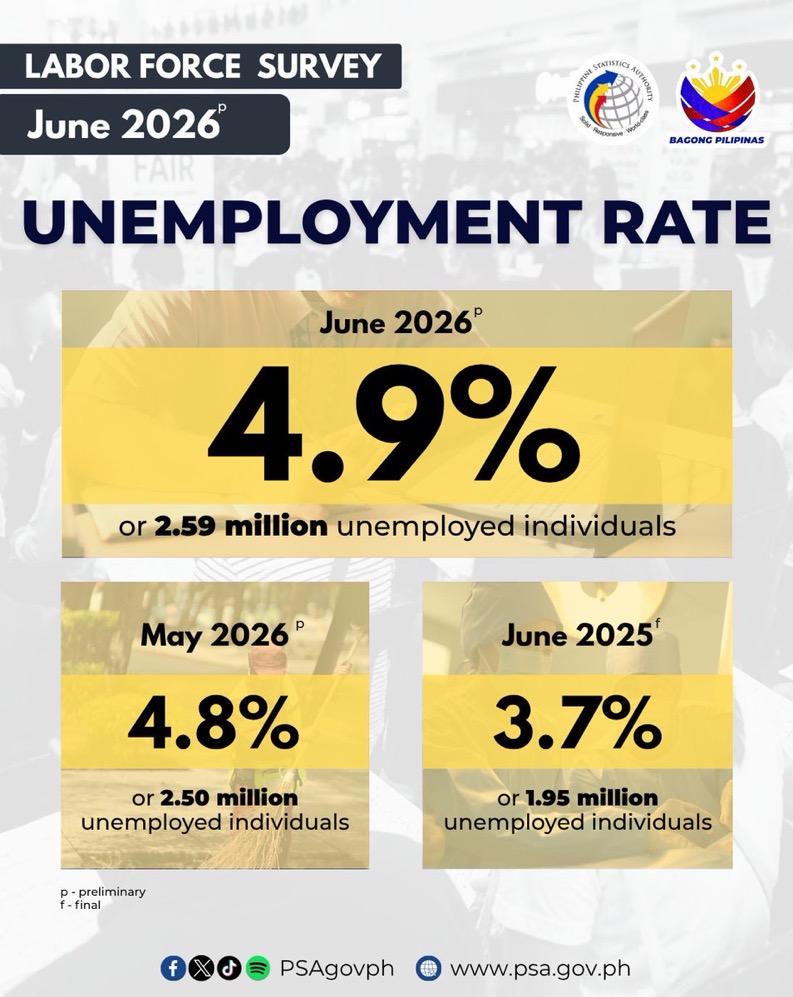
The Philippines’ unemployment rate rose to 4.9 percent in June from 4.8 percent in May, as the number of jobless Filipinos climbed to 2.59 million, underscoring the uneven pace of labor market recovery despite an increase in overall employment.
Data released by the Philippine Statistics Authority on Thursday showed unemployment also remained well above the 3.7 percent recorded a year earlier, with about 640,000 more Filipinos out of work than in June 2025.
Even so, the economy generated more jobs. Total employment reached 50.66 million in June, up from 49.63 million in May and slightly higher than the 50.47 million recorded a year ago, indicating that more Filipinos entered the workforce but not all were immediately absorbed.
The labor force expanded to 53.25 million people, lifting the labor force participation rate to 65.1 percent from 63.8 percent in May, although it remained below the 65.7 percent posted a year earlier. The larger pool of jobseekers partly explains the uptick in unemployment despite higher employment.
The data suggest the labor market is still expanding, but job creation has yet to keep pace with the influx of workers, leaving unemployment elevated even as payrolls continue to grow.
Underemployment, a measure of workers seeking additional hours or better-paying jobs, eased slightly to 12.1 percent from 12.2 percent in May but remained above the 11.4 percent recorded a year ago. Around 6.11 million employed Filipinos said they wanted more work, highlighting persistent concerns over job quality and income.
Services remained the country’s largest employer, accounting for 62.7 percent of total employment, followed by agriculture at 20.0 percent and industry at 17.3 percent.
Accommodation and food service activities posted the biggest annual increase in employment, followed by administrative support services, public administration and defense, and education. By contrast, wholesale and retail trade, fishing and aquaculture, financial services, construction, and healthcare recorded the steepest declines from a year earlier.
The mixed employment picture suggests that while hiring remains resilient in consumer-facing and government-related sectors, weakness in trade, fisheries and construction continues to weigh on broader labor market conditions.