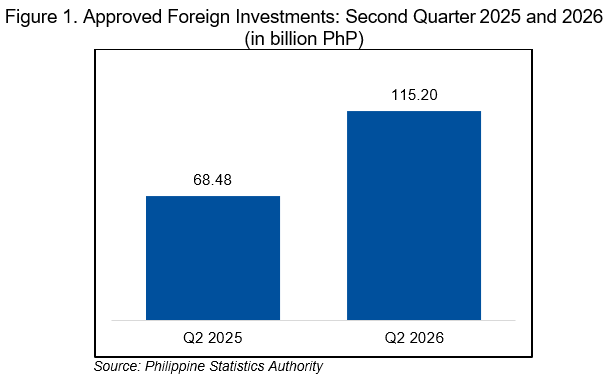
Foreign investments approved in the Philippines surged 68.2 percent year-on-year to P115.20 billion in the second quarter of 2026, signaling stronger overseas interest in the economy even as the job-creation outlook remained less impressive.
The figure was up sharply from P68.48 billion a year earlier, according to the Philippine Statistics Authority. Eight of the country’s 16 investment promotion agencies reported foreign investment approvals during the quarter.
The Netherlands led the pack, accounting for P50.74 billion, or 44 percent of total foreign investment pledges. Germany followed with P18.05 billion, or 15.7 percent, while Singapore contributed P9.95 billion, or 8.6 percent.
Manufacturing was the biggest draw, attracting P78.81 billion, or 68.4 percent of foreign investment approvals. Real estate activities came next with P11.09 billion, followed by electricity, gas, steam, and air-conditioning supply with P8.81 billion.
Geographically, the Cordillera Administrative Region took the biggest slice, receiving P55.74 billion, or nearly half of all foreign investment pledges. Central Luzon followed with P36.81 billion, while CALABARZON received P14.75 billion.
The broader investment picture was even stronger. Total approvals from both foreign and Filipino investors reached P541.51 billion, up 73.1 percent from P312.87 billion a year earlier. Filipino investors accounted for P426.31 billion, or 78.7 percent.
Electricity and related utilities dominated overall approvals with P321.06 billion, followed by manufacturing at P98.06 billion and real estate at P49.38 billion.
Yet there is a wrinkle beneath the headline numbers. Approved projects are expected to generate 32,167 jobs, down 21.9 percent from 41,203 a year earlier. Foreign-backed projects are expected to create 27,266 jobs, or 84.8 percent of the total.
In other words, investment money is arriving in bigger waves, but it may not translate into jobs at quite the same pace. For policymakers, that distinction matters. A strong investment pipeline is welcome, but the real test is how much of it reaches factories, businesses, and workers.