Aboitiz Economic Estates president and CEO Rafael Fernandez de Mesa sees the government’s Pax Silica initiative as a potential catalyst for Philippine industrialization, particularly as the country seeks to attract higher-value industries and move up the global supply chain.
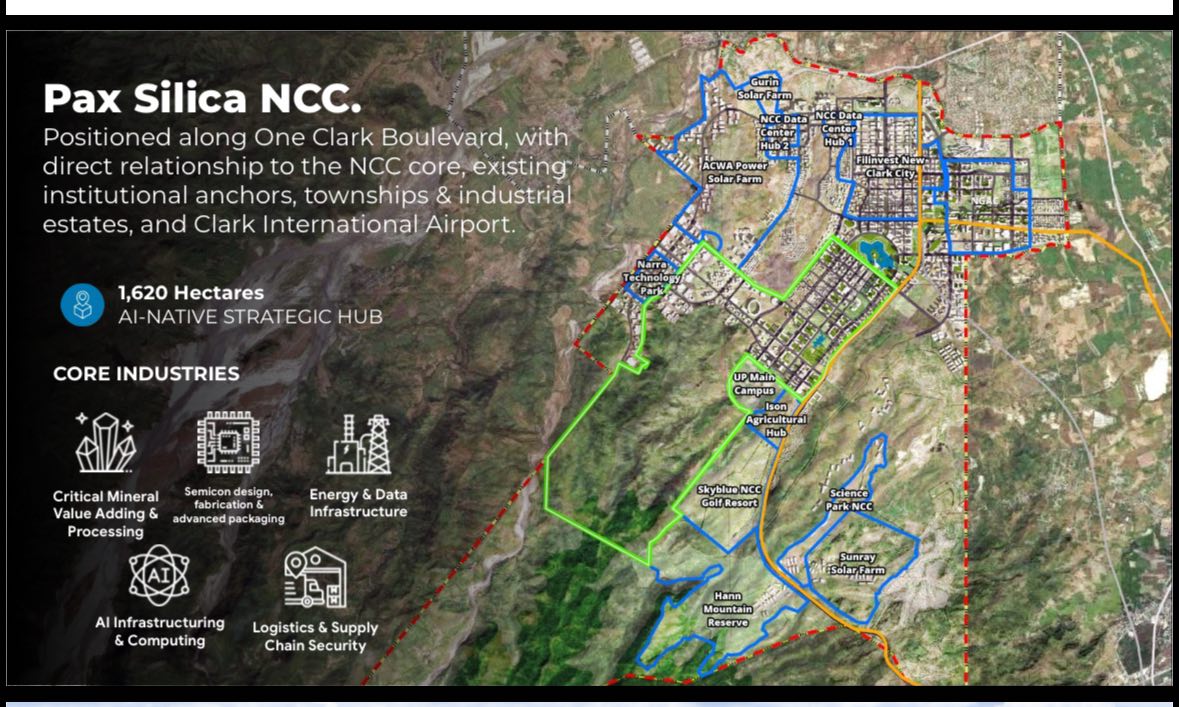
Fernandez de Mesa said the proposed 1,600-hectare Pax Silica development in New Clark City should be viewed as part of the broader industrial ecosystem taking shape across the Luzon Economic Corridor.
“If you look at the project that’s been identified for Pax Silica in New Clark City, you look at the size of it. It’s about 1,600 hectares. 1,600 hectares is just about the size of LIMA, more or less,” he said.
The government’s focus on semiconductors, artificial intelligence, and data-related industries could create significant economic opportunities, he said.
“They want the Philippines to move up the value chain when it comes to semiconductors, and basically, the industries of the future, which are very much related to AI, the data. Why wouldn’t we want that?” Fernandez de Mesa said.
More high-value investments would mean more jobs and opportunities, supporting broader economic growth, he added.
He also rejected concerns that sustainability requirements could discourage investors, noting that global companies are already accustomed to stringent environmental standards.
“I don’t think it’s a turnoff at all,” he said. “These investors are global investors, and they’re not just looking at the Philippines, they’re looking at the globe. So their level of standards are very high, very stringent.”
For Aboitiz Economic Estates, the initiative could also create opportunities in existing industrial hubs, including TARI Estate in Tarlac.
Fernandez de Mesa said investors drawn to the Luzon Economic Corridor would not necessarily need to wait for New Clark City, given the availability of industrial facilities in Batangas and Tarlac.
TARI Estate has already generated local employment through site development, with about 70 percent of workers coming from nearby communities.
Coca-Cola and Ajinomoto are building facilities there, with operations targeted by end-2027 and March 2028, respectively. Another 12-hectare food and beverage investment is also in the pipeline.