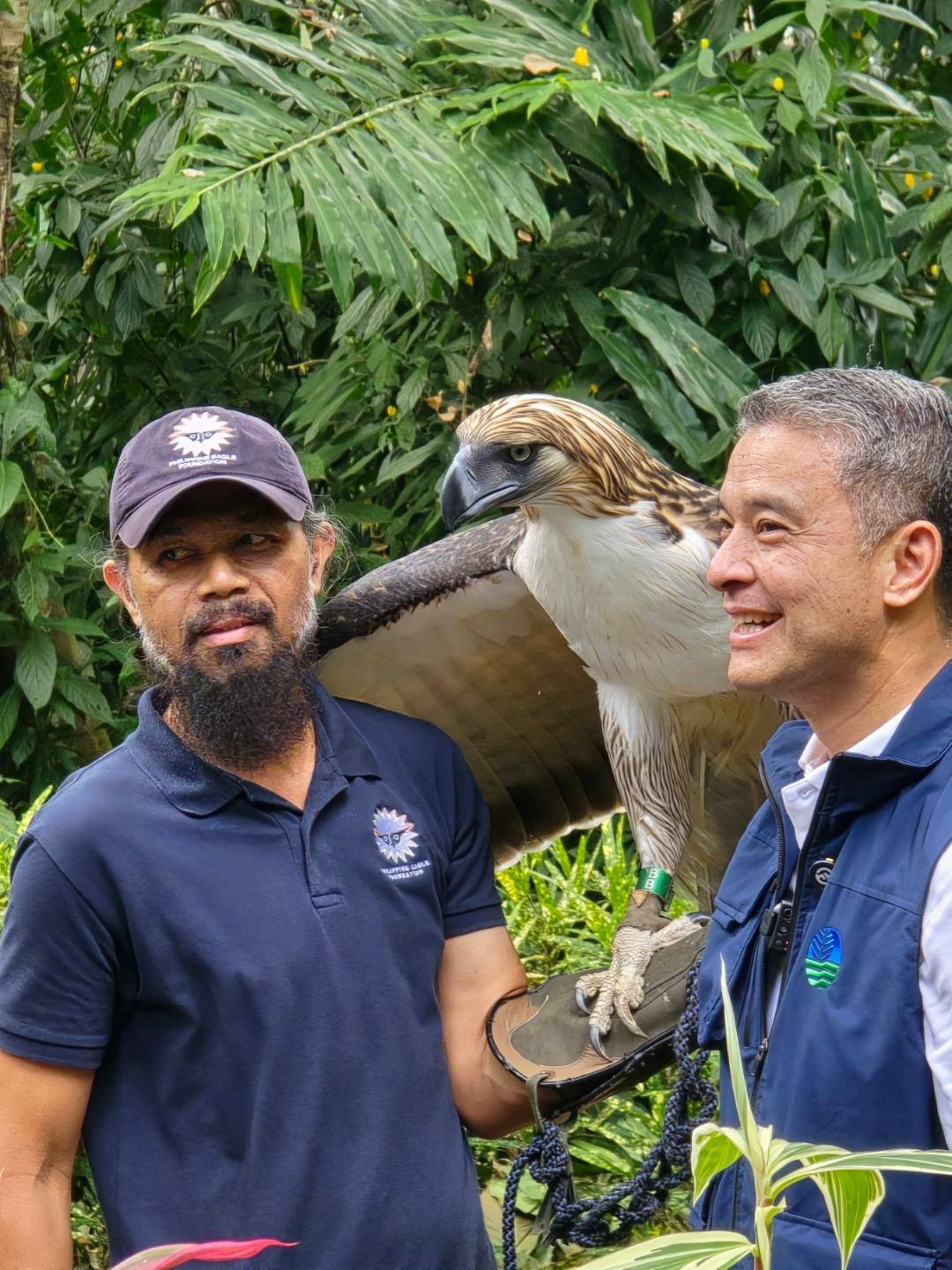
Protecting the Philippine Eagle goes beyond saving a single species—it demands safeguarding entire forest landscapes, upholding Indigenous stewardship, and uniting communities and stakeholders, Environment Secretary Juan Miguel “Mitch” Cuna said during the formal launch of a landmark conservation initiative at the Philippine Eagle Center in Malagos.
The event rolled out the project Integrated Approach in Management of Major Biodiversity Corridors in the Philippines, themed One Eagle. Many Landscapes. Shared Stewardship. Led by the Department of Environment and Natural Resources (DENR) with the United Nations Development Programme (UNDP) and Global Environment Facility (GEF), the effort centers on strengthening community-led conservation planning within selected ancestral domains across the Eastern Mindanao Biodiversity Corridor (EMBC), as part of the broader Biodiversity Corridor Project. It directly advances President Ferdinand R. Marcos Jr.’s directive to boost biodiversity conservation and secure the future of the country’s national bird, one of its most iconic and critically endangered species.
Cuna emphasized that the eagle stands as a vital marker of forest health and ecological balance, making its protection synonymous with preserving rich biodiversity and securing a sustainable future for generations to come. “As a symbol of the health of our forests, the richness of our biodiversity, and our shared responsibility to future generations, protecting the Philippine Eagle means protecting entire landscapes, empowering communities, and investing in a shared future for people and nature,” he stated.
The initiative focuses on enhancing Ancestral Domain Sustainable Development and Protection Plans (ADSDPPs) and integrating customary governance, traditional knowledge, and modern conservation science—including ecosystem management, spatial planning, and community-based monitoring—into local conservation work. It recognizes ancestral domains as critical sanctuaries for the Philippine Eagle and the wide range of endemic species that share these habitats.
Scientific findings underscore this vital link: a 2025 study supported by the Biodiversity Corridor Project and the Philippine Eagle Foundation shows that 46 percent of high-suitability Philippine Eagle nest habitat lies within ancestral domains, rising to 65 percent for core habitat. The Eastern Mindanao Biodiversity Corridor alone holds 35 percent of the country’s total high-quality nest sites. These data confirm that Indigenous territories are not secondary to eagle conservation but form its ecological foundation.
“This initiative recognizes that some of the most important habitats of the Philippine Eagle are found within ancestral domains. By strengthening Indigenous-led planning and stewardship, we are also strengthening the protection of the forests and biodiversity that sustain the eagle and countless other species,” said Philippine Eagle Foundation executive director Dennis Salvador. He noted the project will equip communities with tools to combine traditional wisdom with evidence-based planning, setting clear conservation targets and aligning local goals with national and global biodiversity objectives.
Cuna stressed that effective conservation must extend beyond formal protected areas to embrace lands stewarded by Indigenous Peoples for centuries. “Successful conservation must respect Indigenous rights, strengthen customary governance, and support community-led decision-making,” he said, adding that ancestral domains encompass most of the country’s remaining high-quality forest habitats essential to eagle survival.
Field consultations, assessments, and planning activities will begin in the coming months.
Partners from government agencies, Indigenous political structures, local governments, academic institutions, and conservation organizations expressed confidence that the effort will strengthen biodiversity protection, advance Indigenous self-determination, and secure vital forest refugia for the Philippine Eagle and the many species that depend on these landscapes.