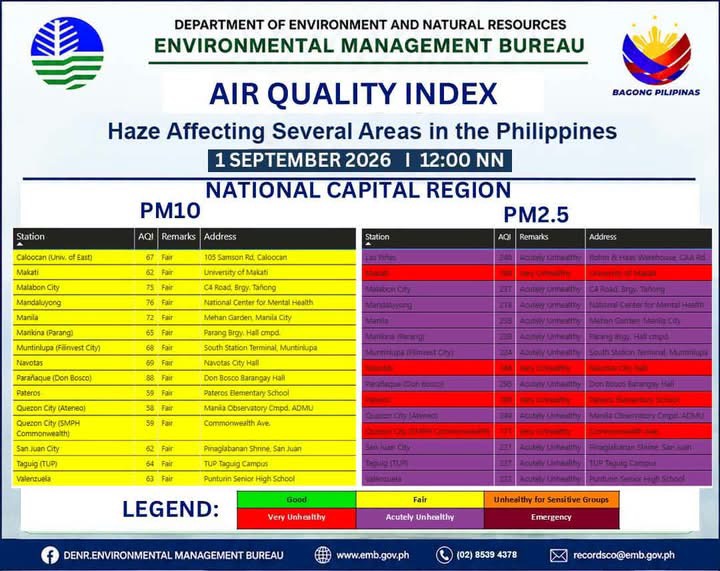
The Department of Environment and Natural Resources — Environmental Management Bureau (DENR-EMB) confirmed Tuesday that fine particulate matter (PM2.5) reached unhealthy levels at every monitoring station in Metro Manila, driven by smoke and haze from ongoing forest fires in Kalimantan, Indonesia carried here by prevailing winds.
As of 2 p.m. today, PM2.5 readings were acutely unhealthy in Las Piñas, Mandaluyong, Malabon, Manila, Marikina, Muntinlupa, Parañaque, Quezon City (Ateneo), San Juan, Taguig, and Valenzuela. Makati, Navotas, Pateros, and Quezon City (Commonwealth) recorded very unhealthy air quality. Coarser PM10 particles registered fair across all 15 stations during the same period.
The haze is expected to also affect Central Luzon, Calabarzon, and Mimaropa. DENR-EMB’s Environmental Quality Management Division Chief Engineer Jundy del Socorro emphasized the situation is largely beyond local control, as it depends on fire intensity, wind patterns, and rainfall outside Philippine territory.
“From September 1 to 3, haze will likely persist as southwest monsoon winds continue transporting smoke from active fires. Rain showers can help clear fine particles and lower pollution levels,” del Socorro explained. He added gradual improvement may come September 4–6 with widespread rain and shifting winds, though no official forecast confirms the timing or extent of clearing. Conditions beyond September 6 will depend on whether fires remain active and wind directions continue carrying smoke toward the country.
The agency urged the public to limit prolonged outdoor activity, especially children, the elderly, and those with respiratory or heart conditions. People going outdoors are advised to wear a well-fitting N95 or equivalent mask. DENR-EMB also reminded the public to remain calm and rely only on official updates, noting that fine PM2.5 particles penetrate deep into the lungs and bloodstream, while PM10 can also cause airway inflammation and reduced lung function.