The Department of Tourism (DOT) is seeking an additional P1.73 billion for 2027 to strengthen the Philippines’ tourism infrastructure, destinations, and promotion as it tries to close an investment gap with more aggressive Southeast Asian competitors.
The proposed funding comes on top of the DOT and its attached agencies’ P5.47-billion allocation under the 2027 National Expenditure Program. Of the requested augmentation, P82.33 million would go to the DOT central office and about P1.65 billion to attached agencies for tourism infrastructure, heritage conservation, parks, dive tourism, and destination development.
DOT Secretary Dita Angara-Mathay told the House appropriations committee on Monday that Philippine tourism remains relatively underfunded despite its growing contribution to the economy.
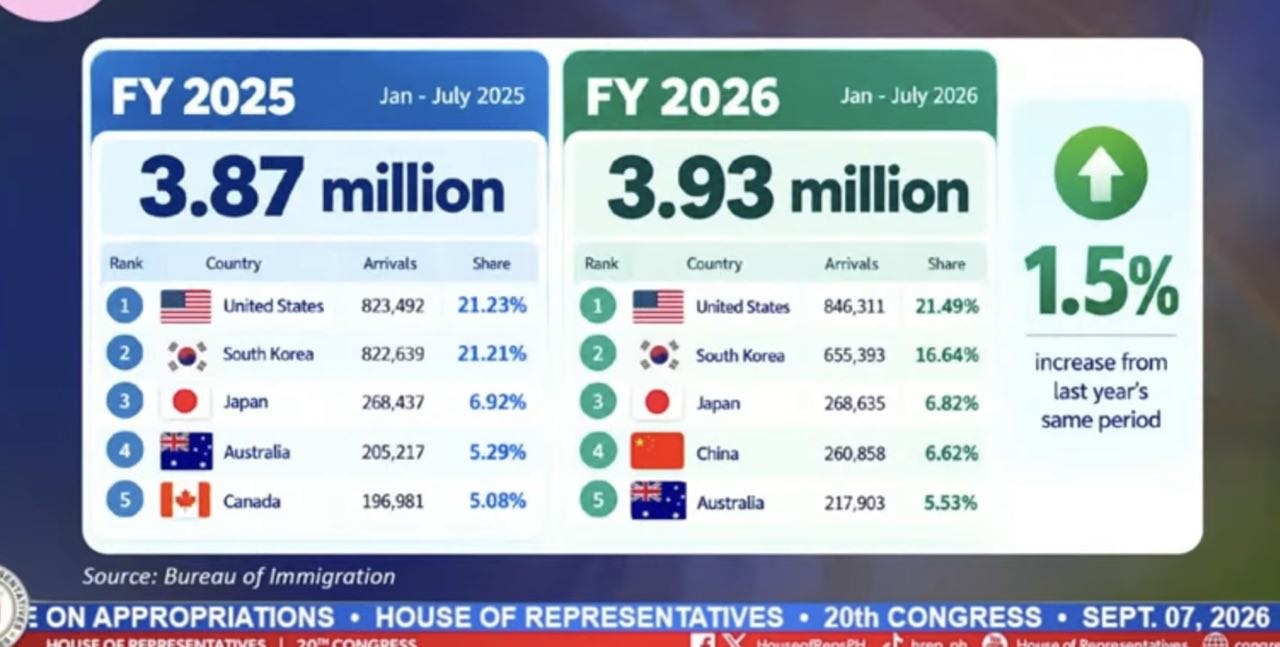
The Philippines ranked sixth in ASEAN in international arrivals in 2025, up from seventh, but its 6.48 million visitors accounted for only about 5 percent of the region’s tourism market. Tourism receipts reached about USD12.15 billion, placing the country fifth in ASEAN.
The funding disparity is also visible in tourism promotion. Philippine government spending on tourism marketing totaled about USD6.68 million in 2025, below several ASEAN competitors, although the DOT said the spending generated about 74,758 arrivals for every USD1 million invested.
Vietnam offers a sharper contrast. Despite having a smaller government branding budget, the country benefits from substantial private-sector tourism investment.
DOT officials cited Sun Group, whose investments span attractions, hotels, accommodations, and entire tourism communities, creating a broader tourism ecosystem beyond conventional destination marketing.
The comparison highlights the challenge facing the Philippines, where stronger promotion alone may not be enough to compete for tourists. The country also needs sustained investment in destinations, connectivity, attractions, and tourism products.
The DOT’s funding request comes as tourism continues to generate significant economic activity. The sector contributed P2.27 trillion to the economy in 2025 and supported 7.7 million jobs, equivalent to nearly one in six employed Filipinos.
For the DOT, the additional funding is intended to strengthen the infrastructure and destinations behind the country’s tourism pitch, giving the Philippines a better chance of converting visitor interest into longer stays, higher spending, and broader economic gains.