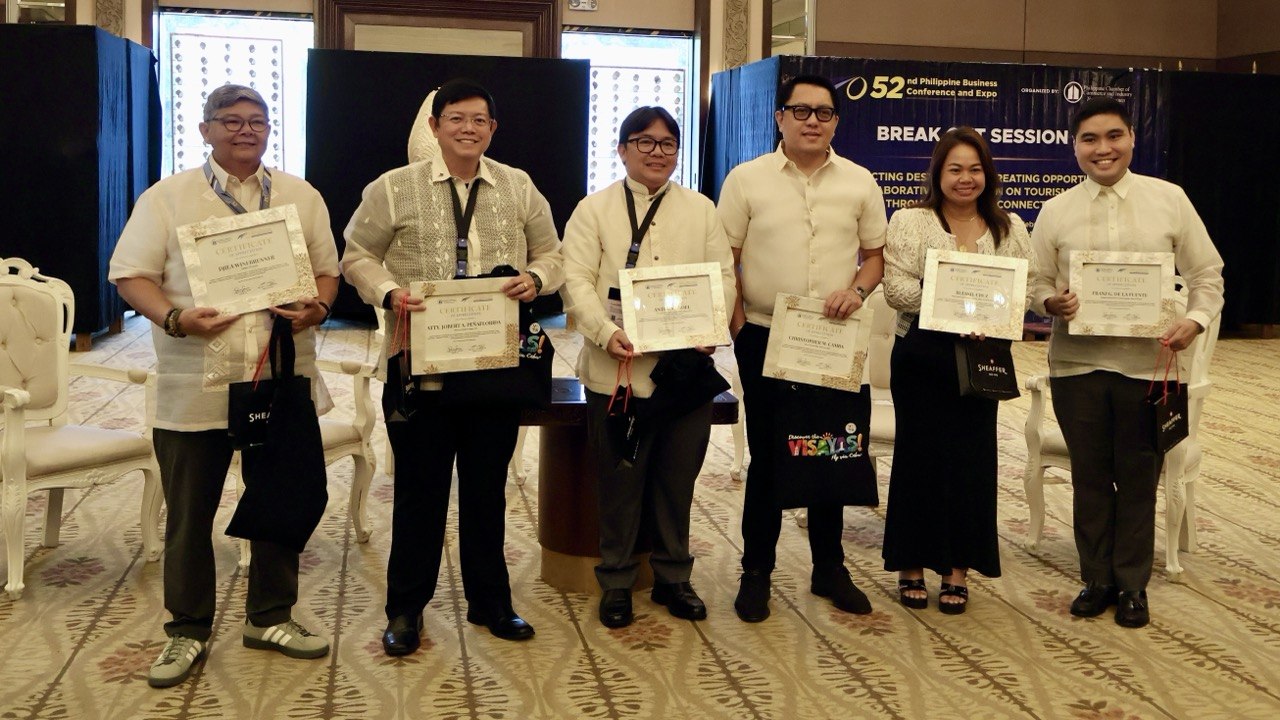
Island business chambers across the Visayas are being urged to lead destination marketing and turn regional connectivity into stronger local business opportunities, as the Visayas Island-Chambers Tourism Alliance (VITA) advances a Cebu-linked tourism strategy.
The action plan was presented October 14 at the 52nd Philippine Business Conference and Exposition at The Manila Hotel, during a breakout session on regional connectivity and tourism growth.
VITA Chairman and Philippine Chamber of Commerce and Industry (PCCI) Lapu-Lapu President Anthony Noel outlined four priorities: package signature local attractions into multi-destination circuits; mobilize hotels, restaurants, craft businesses and transport providers; use Mactan-Cebu International Airport (MCIA) route data to engage local governments; and extend chamber cooperation to trade missions, business exchanges and investment promotion.
The approach seeks to make tourism a broader economic driver rather than simply an exercise in increasing arrivals.
“More routes mean more arrivals. More arrivals only help if visitors stay longer and spend locally,” Noel said, emphasizing the need to develop market-ready experiences and prepare businesses to serve travelers.
For chambers, the proposed benefits extend beyond member sales to include stronger retention, better data for local policy discussions and improved organizational capacity.
Blessie Cruz, Aboitiz InfraCapital’s head of tourism and destination marketing for MCIA, challenged participating chambers to contribute a market-ready experience, link it to an itinerary featuring another destination, and jointly promote the resulting offer.
At the center of the initiative is Discover The Visayas, #FlyViaCebu, a campaign led by VITA with the Department of Tourism, PCCI and airport operator Aboitiz InfraCapital Cebu Airport Corporation.
Cruz described Cebu as a shared gateway through which international and domestic arrivals could access more island destinations.
The strategy’s success, however, will depend on coordination beyond airport connectivity: destinations must align itineraries, transport, infrastructure and business readiness so visitors can travel more easily and spend across communities.
For chambers in Cebu, Bohol, Leyte, Samar, Negros and Panay, the challenge is to convert regional cooperation into bookable experiences and measurable local economic gains.