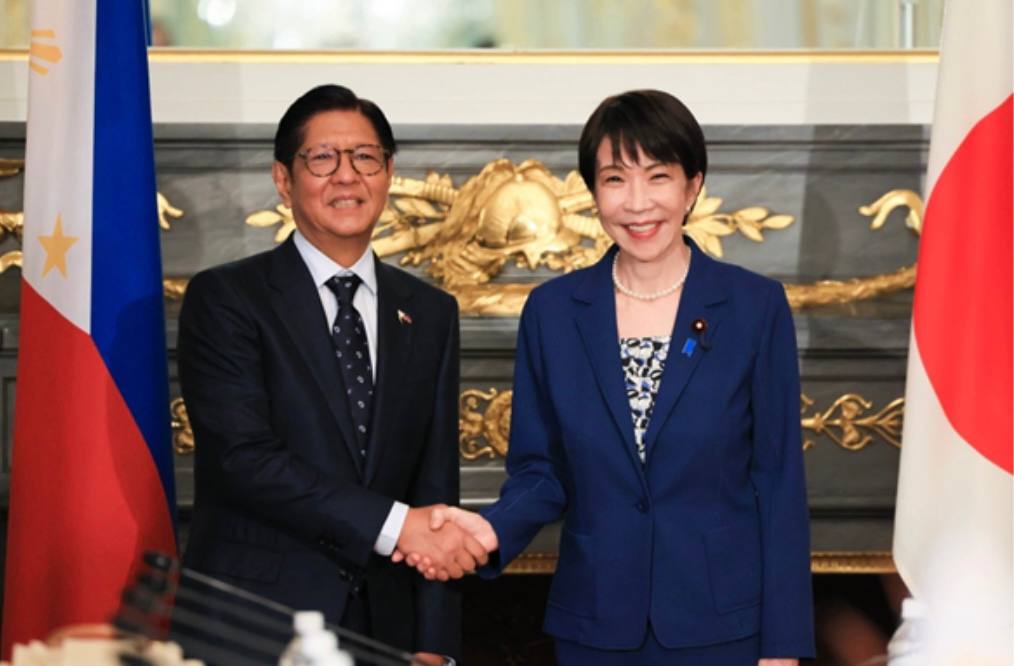
On May 28, during President Ferdinand Marcos Jr.’s state visit to Japan, he and Japanese Prime Minister Takaichi Sanae held summit talks that formalized a new level of bilateral cooperation: the Comprehensive Strategic Partnership — the first such designation for the Philippines. Marking 70 years since relations were established, this upgrade signals a long-term, multi-sector alliance anchored in shared values and a commitment to a Free and Open Indo-Pacific (FOIP), amid growing regional uncertainties.
Policy significance is far-reaching, starting with security and defense. Both nations will begin negotiating an agreement to protect classified military information, laying the groundwork for deeper joint operations and intelligence sharing. Japan has agreed to speed up talks on transferring defense equipment including Abukuma-class destroyers and TC-90 aircraft, building on its expanded rules for defense exports. They also confirmed early plans for the next “2+2” meeting of foreign and defense ministers and will continue support through Official Security Assistance. Maritime cooperation will expand further, with Japan committing more patrol vessels and training to the Philippine Coast Guard to strengthen maritime law enforcement and uphold regional rules-based order.
Economically, the partnership opens major new avenues. Leaders agreed to update the Japan-Philippines Economic Partnership Agreement and the ASEAN-Japan trade pact, while Japan formally backed the Philippines’ bid to join the Comprehensive and Progressive Agreement for Trans-Pacific Partnership (CPTPP), a key step toward greater market access and investment alignment. A new tax convention was signed to boost trade and investment flows. Cooperation will also advance in energy security — including national oil reserves and decarbonization under the Asia Zero Emission Community — critical to the Philippines’ goal of stable, cleaner power supply. Both sides pledged closer coordination on supply chains, critical minerals, artificial intelligence, and digital connectivity under the FOIP Digital Corridor concept.
Development assistance will focus on high-quality infrastructure, disaster resilience, healthcare, and human capital, with special attention to the Luzon Economic Corridor. Japan also reaffirmed strong support for the Mindanao peace process, food security, and space technology collaboration. Several agreements were sealed covering scholarships, agriculture, AI, and stockpiling, with more deals on water management and data protection forthcoming.
On regional security, both leaders voiced grave concern over developments in the East and South China Seas, firmly opposing any unilateral moves to alter the status quo through force or coercion. They reaffirmed support for ASEAN centrality, backed the Philippines’ role as ASEAN chair, and agreed to deepen trilateral coordination with the United States. They also aligned positions on North Korea’s nuclear and missile programs, stability in the Middle East, and free navigation in key waterways. Japan additionally pledged support for the Philippines’ bid for a non-permanent seat on the UN Security Council, solidifying stronger alignment in global governance.
In essence, the summit transforms bilateral relations from traditional aid and trade links into a structured strategic alliance, directly strengthening the Philippines’ defense capabilities, economic competitiveness, energy security, and diplomatic influence across the Indo-Pacific.