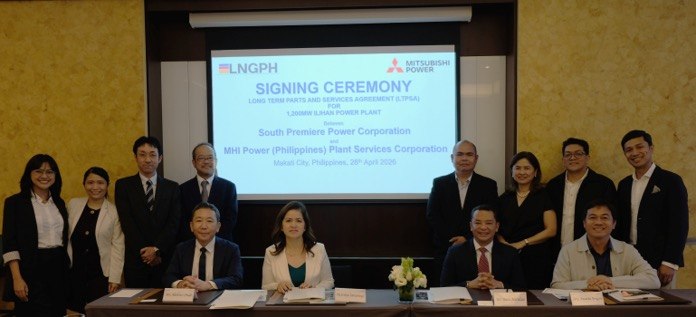
LNGPH has moved to strengthen the long-term reliability of one of the country’s most important power facilities, signing a long-term service agreement with Mitsubishi Power to keep the 1,200-megawatt Ilijan Combined Cycle Power Plant operating at peak performance through the next decade.
The agreement, executed through LNGPH subsidiary South Premiere Power Corp. (SPPC) and MHI Power (Philippines) Plant Services Corp. (MHI-PSC), provides critical spare parts, repair services, hot parts management, inspections, and technical support for the plant’s Mitsubishi M501G gas turbines.
The deal deepens a partnership that dates back to the plant’s commissioning in 2002, when Mitsubishi Power supplied the original turbines. By securing long-term access to parts and specialized technical expertise, LNGPH aims to maximize plant availability, improve operating efficiency, and reduce the risk of unplanned outages amid rising electricity demand.
The Ilijan facility remains a cornerstone of Luzon’s power system and a key anchor of LNGPH’s 2.5-gigawatt integrated liquefied natural gas import, regasification, and gas-to-power complex in Batangas. The project is backed by Chromite Gas Holdings Inc.—a joint venture between Meralco PowerGen Corp. and Therma Natgas Power Inc.—alongside San Miguel Global Power Holdings Corp.
LNGPH President and CEO Yari A. Miralao said the agreement underscores a partnership built over more than two decades and supports the company’s commitment to deliver reliable power through 2040 while helping bolster the country’s energy security.
The move also highlights the growing importance of long-term maintenance strategies as the Philippines leans on natural gas to support grid stability while renewable energy capacity continues to expand. Reliable baseload and mid-merit generation assets such as Ilijan are increasingly viewed as critical to balancing intermittent renewable power and ensuring adequate electricity supply.
For Mitsubishi Power, the agreement reinforces its footprint in the Philippine energy sector, where its technologies account for more than a quarter of installed generating capacity and support efforts to deliver dependable and lower-carbon power generation.