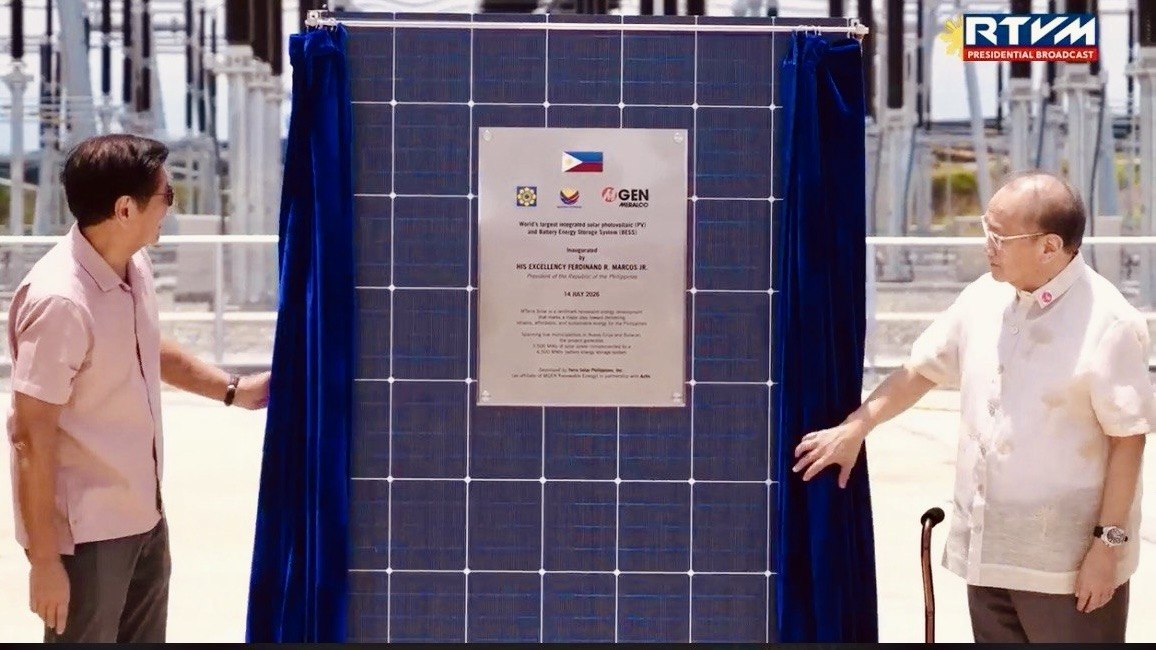
Manila Electric Co., the country’s largest power distributor by sales, is stepping up its renewable energy ambitions after the launch of the first phase of the MTerra Solar project.
Manuel V. Pangilinan, chairman and chief executive officer of the power firm better known as Meralco, pledged that the listed company will invest more in solar and battery storage, in step with the country’s broader push to accelerate the shift toward cleaner energy.
Speaking during Tuesday’s inauguration of MTerra Solar Phase 1 led by President Ferdinand R. Marcos Jr., Pangilinan said the project demonstrates that the Philippines is capable of delivering infrastructure on a world-class scale.
“The world’s largest integrated solar and battery storage facility on a single site rises not in Texas or the Gobi Desert, but here in Gapan, Nueva Ecija,” he said, calling the project proof that the country can execute globally competitive energy developments.
Pangilinan credited the Marcos administration, the Department of Energy, local government units, host communities and investment partner Actis for helping bring the landmark project to fruition.
He said MTerra Solar is only the beginning of Meralco’s clean energy expansion.
“Meralco will keep building more renewables, more batteries, more jobs, until reliable clean energy ceases being a privilege and becomes a birthright for all Filipinos,” Pangilinan said.
Developed by Terra Solar Philippines Inc., a joint venture between SP New Energy Corp. and Actis, Phase 1 has energized 1,373 megawatts of solar photovoltaic capacity and 825 megawatts of battery energy storage, making it the world’s largest operational integrated solar-and-battery facility on a single site.
President Marcos said the first phase is already about 91 percent complete and is expected to reach full commercial operations by August, while Phase 2 is targeted for completion by 2027.
Once fully operational, the facility will deliver up to 3,500 megawatts of solar capacity supported by 4,500 megawatt-hours of battery storage, enough to supply electricity to more than 2.4 million households.
Marcos said the project will also reduce carbon emissions by about 4.3 million metric tons annually while generating nearly P23 billion in economic benefits over the next decade through jobs, tax revenues and increased financial support for host communities, reinforcing the country’s transition toward a cleaner and more resilient energy sector.