Filipino women and young workers may soon find artificial intelligence acting less like a helpful office assistant and more like an ambitious new colleague eager to take over routine tasks.
The International Labour Organization (ILO) said the Philippines has the highest share of workers exposed to generative artificial intelligence (GenAI) among comparable economies in Southeast Asia, with more than 12.7 million workers, or over one in four jobs, potentially affected as businesses increasingly deploy AI tools.
That sounds alarming, but the ILO cautioned against confusing exposure with extinction.
AI is expected to reshape jobs far more often than eliminate them outright. Only 3.6 percent of Philippine jobs fall into the highest-risk category for displacement, suggesting that most workers will likely see their roles rewritten rather than erased.
The disruption, however, will not be evenly shared.
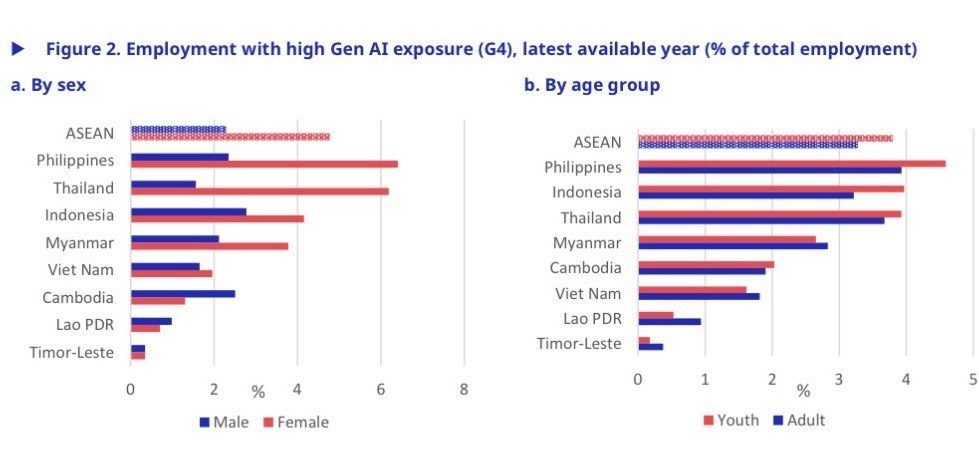
Women face roughly twice the level of AI exposure as men because they dominate clerical, administrative, customer service and many professional occupations where repetitive knowledge-based tasks can be automated. Ironically, higher educational attainment offers no guaranteed shield. Women in knowledge-intensive office jobs could find themselves among the first to work alongside AI, or compete with it.
Young workers present another challenge. Although their overall exposure is slightly lower than that of adults, they are heavily concentrated in entry-level service, sales and clerical positions that AI can increasingly perform. Young women stand to bear the greatest impact.
For employers, AI promises faster workflows and higher productivity. For workers, it raises a different question. How quickly can they acquire the skills machines cannot easily replicate?
The ILO said the answer lies not in resisting AI but in preparing for it. Governments, employers and labor groups should expand AI literacy, digital training and reskilling programs while strengthening worker protections and social dialogue.
The race, it appears, is no longer humans versus machines. It is skills versus obsolescence.