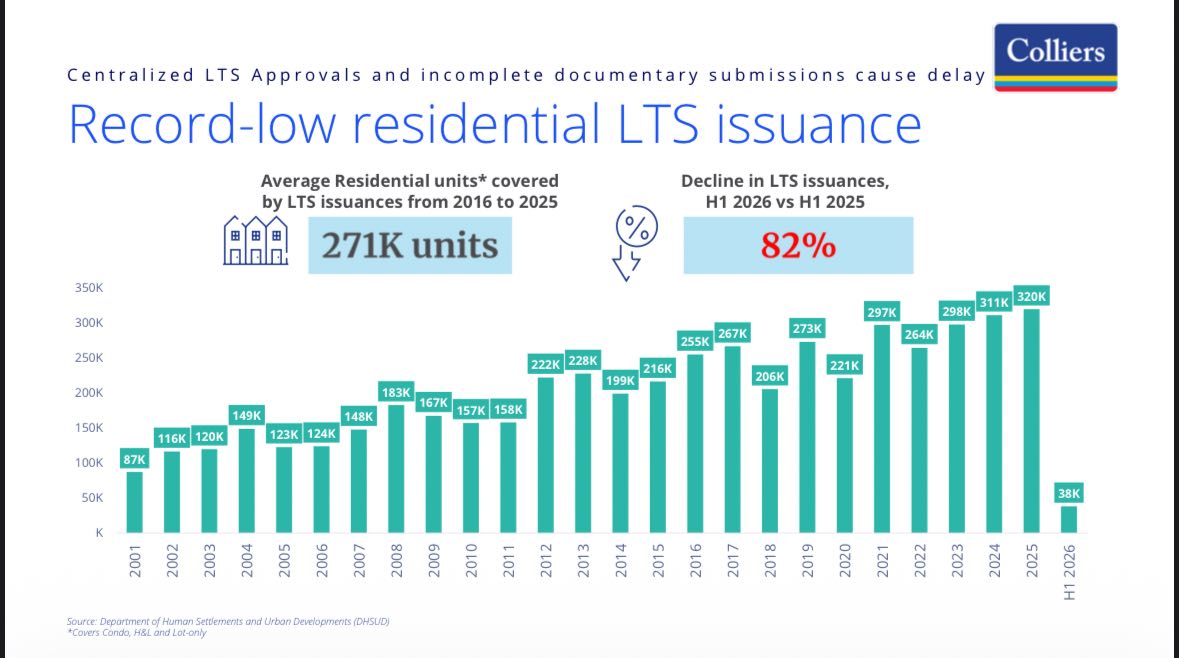
The Philippines’ housing pipeline is showing signs of strain, not because buyers have disappeared, but because fewer projects are making it through the regulatory process.
Property consultancy Colliers said delays in securing License to Sell (LTS) approvals have pushed new residential project approvals to their lowest level in two decades, raising concerns that future housing supply could fall short of demand, particularly in fast-growing provincial markets.
“The residential sector’s biggest challenge today isn’t merely slower demand or elevated vacancy. It is the bottleneck in securing License to Sell approvals,” said Joey Bondoc, head of Research at Colliers Philippines. “When permits move at a crawl, project launches stall, supply gets delayed and housing delivery struggles to keep pace with demand.”
During the first half of 2026, LTS approvals covered only about 38,000 residential units, an 82 percent drop from the historical annual average of 271,000 units recorded between 2016 and 2025. The figure marks the weakest level in at least 20 years.
The slowdown cut across housing segments, with only about 11,000 house-and-lot units and 12,000 condominium units receiving approvals during the period.
Ironically, the weakness comes as demand outside Metro Manila remains healthy.
Colliers said residential take-up rates in Cavite, Bulacan, Laguna, Pampanga, Cebu, Iloilo, Davao and Cagayan de Oro range from 82 percent to 96 percent, suggesting buyers continue to absorb projects once they reach the market.
“The problem is increasingly becoming one of supply availability rather than lack of interest,” Bondoc said.
Metro Manila presents a different picture. The condominium market continues to grapple with elevated vacancies as new completions outpace demand. Vacancy is projected to rise to 25.6 percent by year-end from 24.9 percent in the second quarter.
The diverging trends underscore a growing mismatch in the housing market. While the capital is still digesting excess condominium inventory, high-growth provincial markets risk running short of new supply unless regulatory approvals accelerate. For developers, the next competitive advantage may depend less on finding buyers than on getting projects approved.