Shell Pilipinas Corp. expects a stronger second half of 2026 as fuel demand recovers, commercial businesses remain resilient, and market volatility eases, even as competition in the Philippine fuel market intensifies.
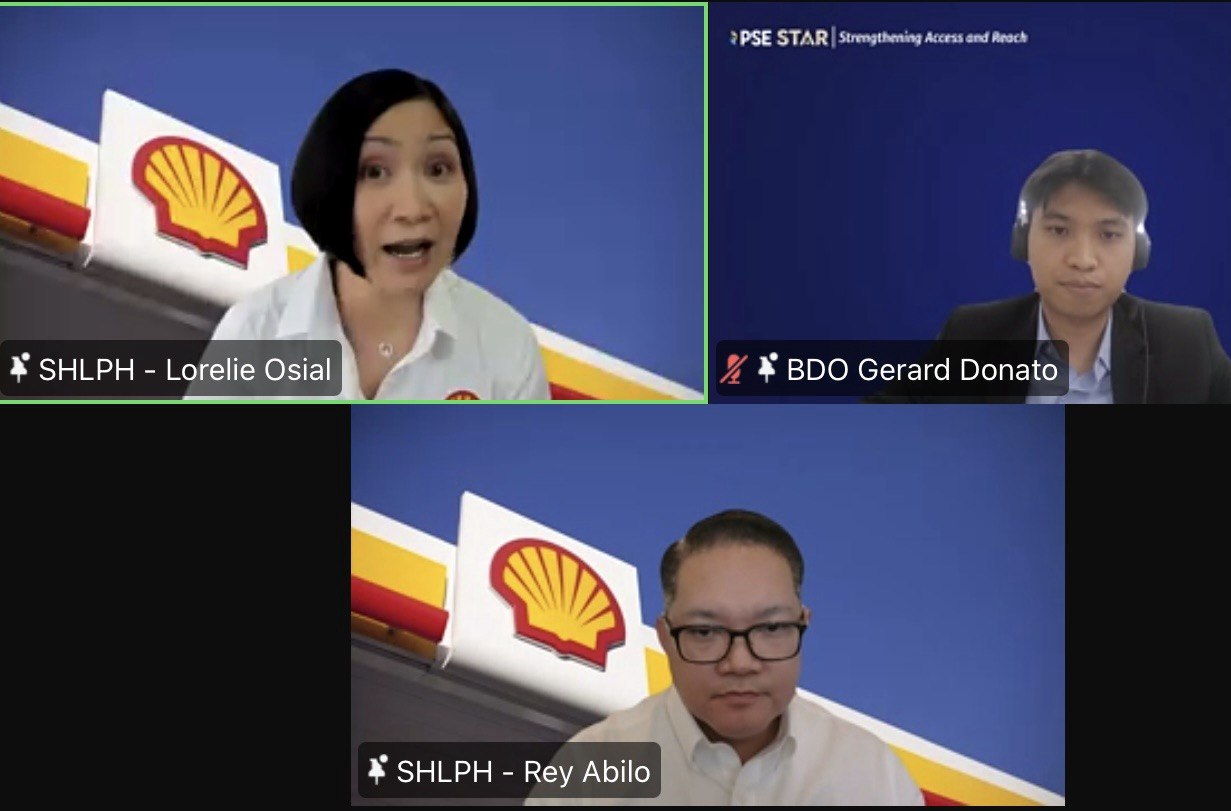
At the PSE STAR Investor Day on Tuesday, Shell Pilipinas President and CEO Lorelie Q. Osial said the company entered the second half with improving momentum as supply disruptions and extreme price swings eased, while mobility showed signs of recovery.
“If market conditions remain broadly stable, we expect the second half to be stronger than the first,” Osial said.
The outlook comes as Shell Pilipinas navigates what Chief Risk Officer and Treasurer Reynaldo Abilo described as a “hyper competitive fuels market,” with smaller independent players continuing to gain market share.
The company plans to grow volumes faster than the industry by expanding into underserved areas and business segments.
Its Davao import terminal, which opened last year, has already supported volume growth, while a fifth import terminal in the Visayas is targeted to open by yearend.
The additional terminal is expected to strengthen Shell Pilipinas’ supply flexibility while giving the company greater reach in regional markets.
For the second half, management will focus on recovering margins, maximizing commercial opportunities, and sustaining volume momentum, particularly in commercial fuels and lubricants.
Capital spending, meanwhile, will remain measured. Shell Pilipinas plans to allocate about P2 billion to P3 billion annually in 2025 and 2026, before increasing annual capital expenditures to around P3 billion to P4 billion from 2027 to 2030 to support its longer-term growth plans.
Despite a challenging first half, the company generated P2.4 billion in free cash flow.
Management said disciplined spending and working-capital management would remain central to navigating an industry where recovering demand is increasingly being matched by aggressive competition.
For Shell Pilipinas, the second half is shaping up as a test of execution, with improving fuel demand providing an opportunity to rebuild margins and translate stronger volumes into sustainable growth.