The Philippines is participating in Asia’s artificial intelligence-driven electronics boom, but its presence remains concentrated in fewer product categories than several ASEAN peers, limiting its exposure to the broader wave of semiconductor, networking and data-center investment, according to the ASEAN+3 Macroeconomic Research Office (AMRO).
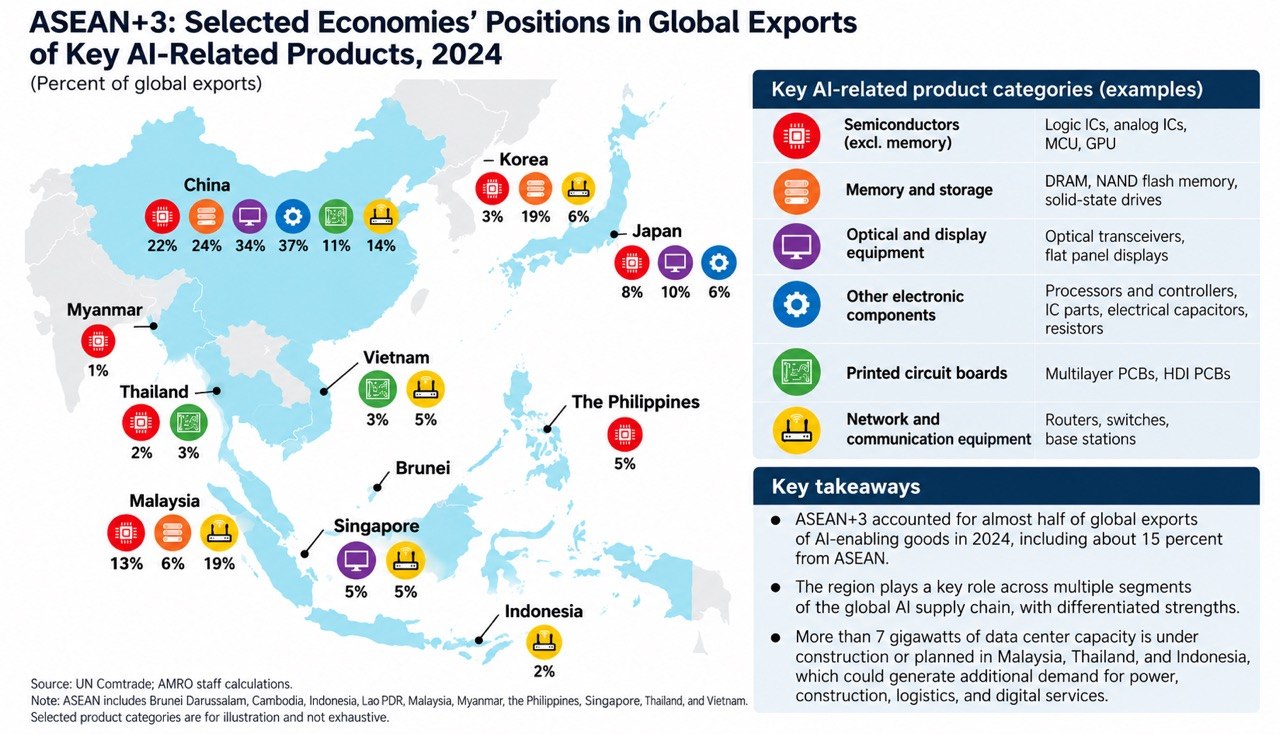
AMRO said ASEAN+3 accounted for nearly half of global exports of AI-enabling goods in 2025, while ASEAN alone supplied about 15%, highlighting the region’s growing role in the global AI supply chain.
The Philippines’ most prominent position in AMRO’s mapping is in analog and amplifier integrated circuits, where it accounts for about 5 percent of global exports in the identified product category.
By comparison, Malaysia, Singapore, Thailand and Vietnam appear across a wider range of AI-related products, including semiconductor components, storage equipment, optical products, circuit boards and networking gear. AMRO cautioned that the mapping is illustrative and does not capture the full extent of each economy’s AI-related industries.
The gap is becoming more significant as AI-related trade increasingly drives regional growth. ASEAN+3 merchandise exports jumped 23.4 percent in the first half of 2026, with AI-enabling goods accounting for more than two-thirds of the increase. Imports rose 26.7 percent, partly reflecting stronger purchases of components and capital equipment needed to expand technology production.
Investment is also extending beyond semiconductor and electronics factories. AMRO said more than 7 gigawatts of data-center capacity is under construction or planned across Malaysia, Thailand and Indonesia, creating potential spillovers for construction, power generation, logistics and digital services.
For the Philippines, the developments point to an opportunity to broaden its role beyond established electronics activities and attract investment into higher-value segments of the AI supply chain.
That shift, however, would require deeper domestic linkages. AMRO said the eventual economic payoff from the technology boom will depend partly on countries’ ability to integrate local suppliers and expand cloud and AI adoption.
Capturing a larger share of the AI cycle for the Philippines therefore involves more than increasing electronics exports. It also means building the industrial, digital and supplier capabilities needed to translate foreign investment into broader productivity gains and higher-value domestic activity.