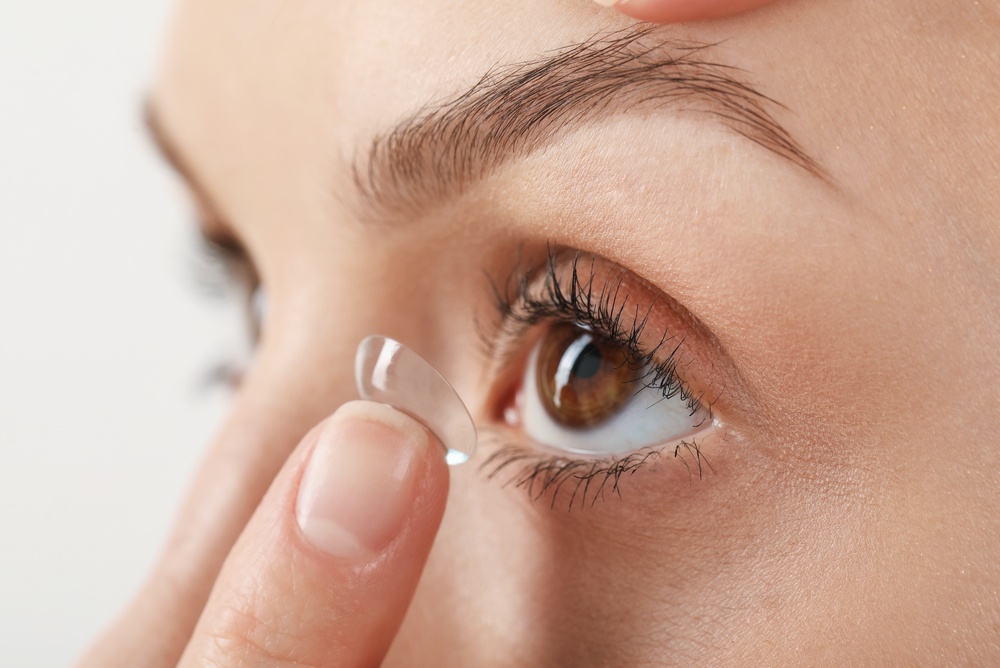
In a development that feels halfway between neuroscience and a particularly ambitious episode of “Black Mirror,” researchers have created contact lenses that may someday help treat depression by delivering tiny electrical signals to the brain through the eyes.
Yes, contact lenses. A treatment for depression.
The experimental lenses were developed by scientists from Yonsei University and detailed in the journal Cell Reports Physical Science. In laboratory tests, depressed mice that wore the lenses for 30 minutes a day over three weeks improved about as much as mice treated with Prozac, one of the world’s best-known antidepressants.
The premise sounds odd until researchers explain that the eye is technically part of the brain. That makes it less “weird sci-fi eyeball gadget” and more “unexpected shortcut through human anatomy.”
“Because the eye is anatomically a part of the brain, we wondered whether a simple contact lens could serve as a gentle, non-invasive doorway to brain circuits that control mood,” said lead researcher Jang-Ung Park.
The lenses contain microscopic electrodes that send mild electrical signals through the retina. The technique, known as temporal interference, allows two harmless signals to overlap deep inside the eye, where they activate only specific brain pathways linked to mood regulation. Think less electric shock therapy and more brain whispering.
Researchers compared four groups of mice, including untreated mice and mice given fluoxetine, the active ingredient in Prozac. The contact-lens mice showed behavioral improvements, healthier brain activity, lower stress hormone levels, and higher serotonin levels.
Even more impressive, a machine-learning system analyzing the mice’s behavior grouped the treated mice closer to healthy mice than to untreated depressed ones. Somewhere in a lab, artificial intelligence essentially looked at a depressed mouse and said, “Actually, this one seems emotionally stable now.”
Scientists caution that human applications remain years away and still require major safety testing. Still, the research hints at a future where mental health treatment could involve putting on contact lenses instead of opening a prescription bottle.
Which, admittedly, would make losing your contacts considerably more stressful.