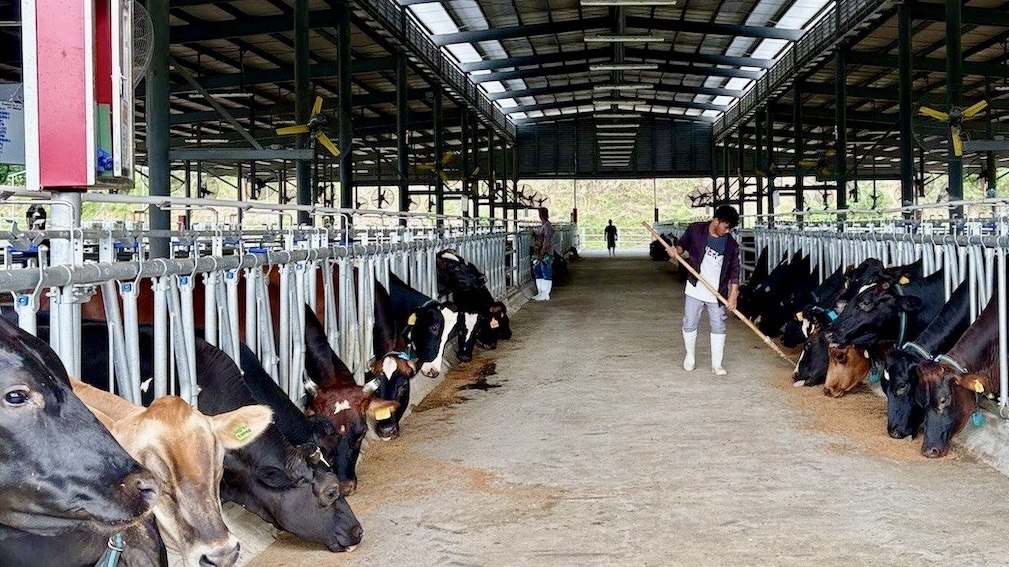
The Philippines is tapping Spanish dairy expertise to help accelerate efforts to raise local milk production, as government and industry partners move to address one of the country’s most persistent agricultural supply gaps.
ABI Pascual Foods, Inc., Spanish dairy company Calidad Pascual, and the National Dairy Authority (NDA) are deepening cooperation to improve farm productivity and boost milk yields, supporting the government’s goal of increasing milk self-sufficiency to 5 percent by 2028 from about 2 percent today.
The partnership follows an NDA learning mission to Spain earlier this year and a subsequent visit by representatives from Calidad Pascual and ABI Pascual to the NDA’s pilot dairy farm in Nueva Ecija, where they assessed how international best practices can be adapted to local conditions.
The collaboration comes at a critical time for the Philippine dairy industry. Despite steady growth in demand, domestic production remains limited, leaving the country heavily reliant on imported milk and dairy products. Raising productivity, rather than simply expanding herd sizes, is increasingly seen as the fastest path toward narrowing that gap.
The joint assessment identified opportunities to improve herd management, feeding systems, animal nutrition, and farm operations. Nueva Ecija is expected to serve as a testing ground for productivity-enhancing measures that could later be rolled out to NDA-supported dairy farms nationwide.
“Our collaboration with the NDA is a long-term commitment to building a more productive and resilient Philippine dairy sector,” said ABI Pascual Foods Board Member Michael G. Tan.
The productivity gap remains substantial. While many local dairy farms produce about 10 liters of milk per cow daily, some farms in Nueva Ecija have reached roughly 15 liters. By comparison, farms working with Calidad Pascual in Spain average around 38 liters per cow per day.
Industry stakeholders view that gap not as a limitation but as evidence of untapped potential. Through technical cooperation, knowledge transfer, and possible deployment of Spanish dairy specialists, the partners aim to help Filipino farmers adopt more efficient production practices, strengthen farm profitability, and gradually reduce the country’s dependence on imported dairy products.