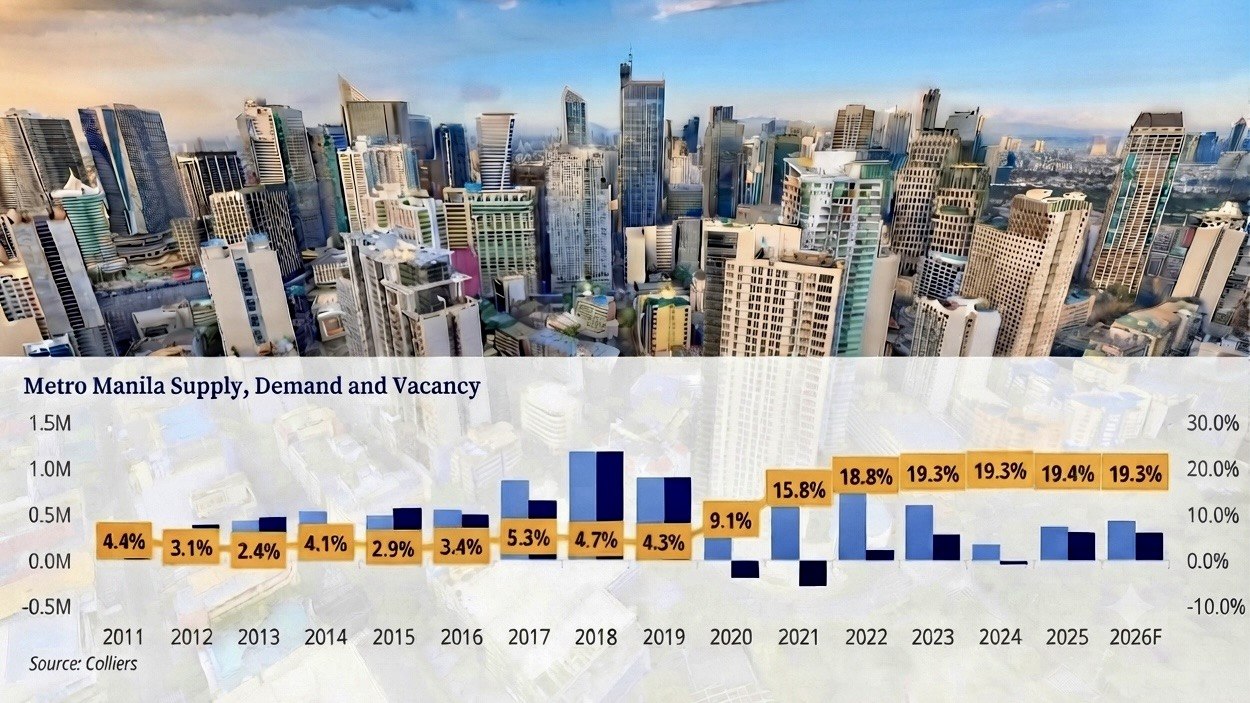
Metro Manila’s office market is showing signs of resilience despite slower leasing activity, with Colliers Philippines saying companies and landlords that move early on lease renewals, embrace flexible workspaces, and invest in sustainability will be best positioned as demand gradually recovers.
The property consultancy said office transactions fell 24 percent quarter on quarter to 145,000 square meters in the second quarter as occupiers postponed expansion plans, opted to renew existing leases, and deferred major capital spending amid geopolitical uncertainty, including the ongoing Middle East conflict.
Even so, Colliers said the market’s underlying fundamentals remain intact. Vacancy held steady at 19 percent while office space surrenders remained limited, suggesting businesses are delaying decisions rather than permanently scaling back.
A key catalyst could emerge from Administrative Order No. 45, which reopens Metro Manila to new Philippine Economic Zone Authority-accredited office developments after years of limited supply. Colliers said the policy should expand location options for information technology and business process management firms, the sector that continues to anchor office demand.
Against that backdrop, the consultancy urged occupiers to begin lease renewal negotiations 18 to 24 months before contracts expire to secure better rental terms and prime locations before fresh PEZA-certified inventory enters the market.
Companies facing uncertain hiring or expansion plans should also consider flexible workspaces and managed offices, which require less upfront capital, offer greater scalability, and reduce the risks associated with long-term lease commitments.
For landlords, Colliers said sustainability has shifted from a value-added feature to a leasing requirement. Green-certified buildings accounted for 68 percent of office transactions in the first half of 2026, prompting developers to pursue certifications such as LEED, EDGE, and BERDE while incorporating renewable energy and energy-efficient building systems.
The consultancy also encouraged developers to prioritize projects near rail stations and major transport corridors, arguing that transit-oriented locations will become increasingly attractive as new infrastructure improves commuter access and supports return-to-office strategies.
Headline and transacted rents remained largely stable across Makati CBD, Bonifacio Global City, and Ortigas CBD in the first half, and Colliers expects rents to stay broadly flat through 2026. While no new office projects were completed during the period, about 434,000 square meters of fresh supply is expected in the second half, with annual deliveries averaging 351,000 square meters through 2030. Despite the additional supply, Colliers forecasts vacancy at a manageable 19.3 percent, signaling a market that remains soft but increasingly positioned for recovery.