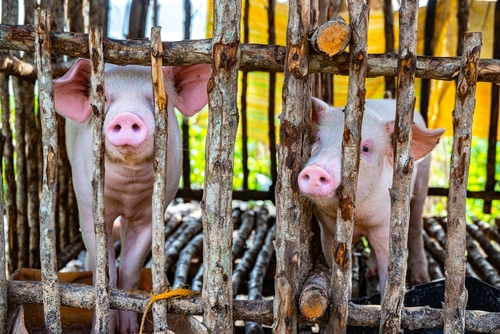
The Philippine hog industry produced more pork in the second quarter, but hog raisers were paid sharply less for it.
Hog production climbed to 412,280 metric tons, liveweight, from April to June 2026, up 5.6 percent from 390,490 metric tons during the same period last year, preliminary Philippine Statistics Authority data showed.
But the production increase came as the country’s hog inventory shrank.
The Philippines had 8.93 million hogs as of June 30, down 1 percent from 9.01 million a year earlier. That means the industry managed to raise output even with a slightly smaller herd, pointing to stronger production or faster movement of hogs to market.
For producers, however, the price picture was far less encouraging.
The average farmgate price of slaughter hogs plunged over 18 percent to P172.44 per kilo, from P211.91 per kilo a year earlier.
Prices also showed little sign of a major rebound during the quarter, averaging P174 per kilo in April before slipping to P171.56 in May.
That creates a tricky equation for hog raisers: more production, but significantly less money at the farmgate.
The biggest production gains were concentrated in several major hog-producing areas. Central Luzon led the country with 58,450 metric tons, accounting for 14 percent of national output. CALABARZON followed closely with 58,350 metric tons, while Northern Mindanao produced 51,720 metric tons.
Central Visayas and Davao Region rounded out the top five. Together, the five regions supplied 55 percent of the country’s hog production during the quarter.
CALABARZON posted the largest year-on-year increase, adding 5,490 metric tons to its output.
The industry’s structure also remains heavily dependent on small farms. Smallhold operations accounted for 79 percent of the country’s swine inventory, compared with 19 percent for commercial farms.
The latest numbers point to a recovery in production—but not necessarily in profitability. For hog raisers, the challenge now is producing more while navigating a farmgate market that is paying considerably less.