New NAIA Infra Corp. (NNIC) has remitted P78 billion to the national government and poured P6.8 billion into rehabilitation and modernization works at the Ninoy Aquino International Airport (NAIA) since taking over operations of the country’s main gateway on September 14, 2024, marking substantial early progress under the public-private partnership (PPP) framework. As of August 15, 2026, the P78 billion in payments covers the P30-billion upfront fee, fixed P2-billion annual payments, and 82.16 percent share of gross airport revenues, as stipulated in the 15-year concession agreement—an arrangement designed to deliver steady public funds while channeling private capital into critical infrastructure.
NNIC president Ramon S. Ang emphasized the dual benefit of the concession model, noting that the structure generates significant ongoing government revenue to support public services while bringing in private sector expertise and funding to upgrade national aviation infrastructure. “This is what the concession was meant to achieve: substantial and continuing revenues for government, paired with private sector resources to improve the airport,” Ang said. He added that while notable milestones have been reached in less than two years, the multi-year modernization program remains ongoing, with all work carried out while keeping the fully operational airport running smoothly.
The P6.8 billion invested so far forms part of a broader upgrade program covering completed and ongoing repairs, equipment replacement, and capacity enhancements. Physical improvements include expanded and reconfigured terminal curbsides, such as eight additional vehicle lanes at Terminal 2 and newly opened Arrivals Curbs C and D at Terminal 1 to ease congestion. A dedicated Ground Transportation Center is under development at Terminal 3 to streamline transport services at the airport’s busiest terminal. Parking systems across Terminals 1, 2 and 3 have been fully automated, while passenger amenities have been upgraded with over 2,500 new baggage trolleys, nearly 12,000 passenger seats, and 20 new inter-terminal shuttle buses. Supporting infrastructure has also been strengthened, with improved Wi-Fi capacity, upgraded power and air conditioning systems, and enhanced elevators, escalators, walkalators and restroom facilities. Baggage handling systems have been upgraded, and new passenger boarding bridges are being installed in phases to minimize operational disruption.
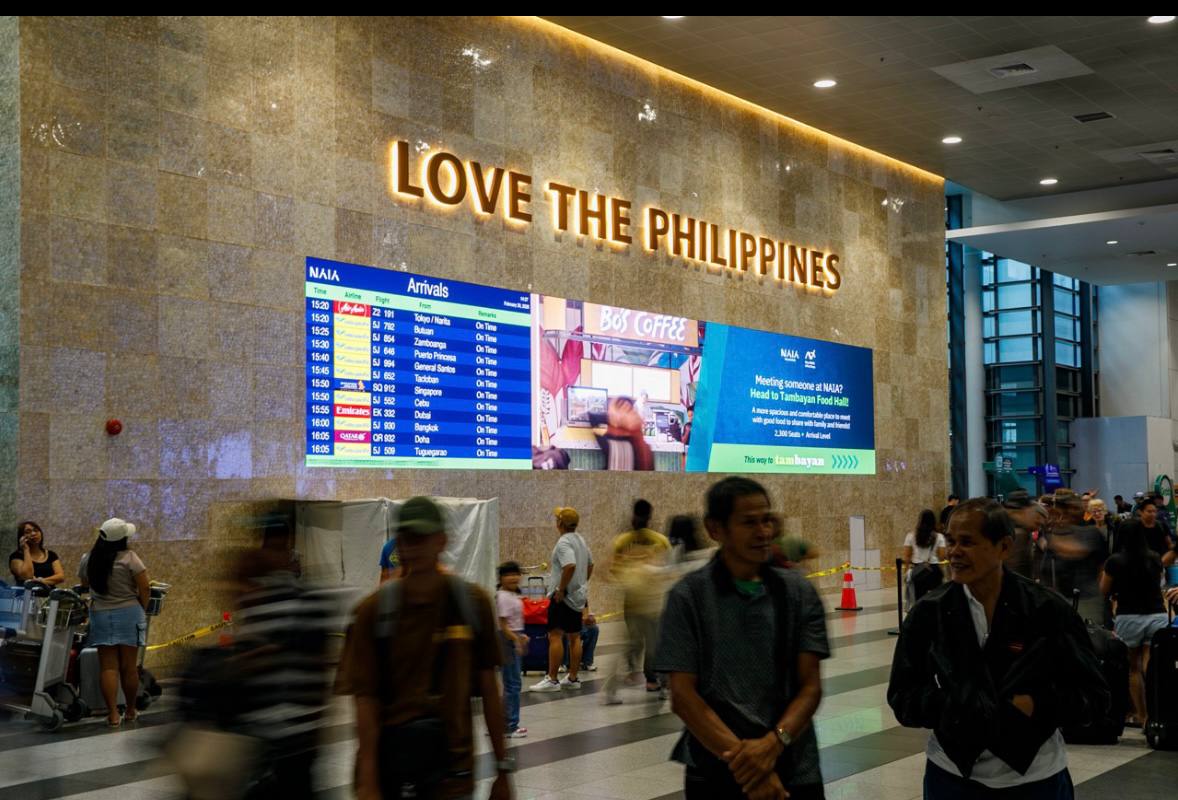
Digital and processing upgrades have accelerated passenger flow, with 517 biometric-enabled units deployed across check-in, security and boarding points, alongside self-service kiosks and automated gates that cut processing times. NNIC also funded 78 new biometric immigration e-gates at Terminals 1 and 3, capable of clearing eligible travelers in roughly 20 seconds and boosting peak-hour capacity. Wayfinding signage and flight information systems have been updated for better clarity and real-time accuracy, while flood mitigation works around the airport have improved drainage and reduced flood risk. Operational refinements including airline terminal reassignments, optimized aircraft parking layouts, and standardized service agreements with carriers and service providers have further lifted efficiency.
Passenger experience has drawn international recognition, with NAIA ranking seventh globally for layover food options and sixth for affordable lounge access in a 2026 Airport Parking and Hotels study of the world’s 50 busiest airports, following the rollout of more than 65 new dining and retail concepts across the terminals. The airport also earned its first Airport Customer Experience Accreditation from Airports Council International in 2025, with a passenger satisfaction score of 4.06 out of 5—exceeding the concession’s 4.0 performance requirement. These upgrades have enabled NAIA to handle traffic far exceeding its original 35-million annual passenger design capacity, serving a record 52.02 million travelers in 2025 while maintaining operational stability. Under the concession, NAIA remains government-owned, with NNIC tasked with operation, maintenance, rehabilitation and expansion through the 15-year term.