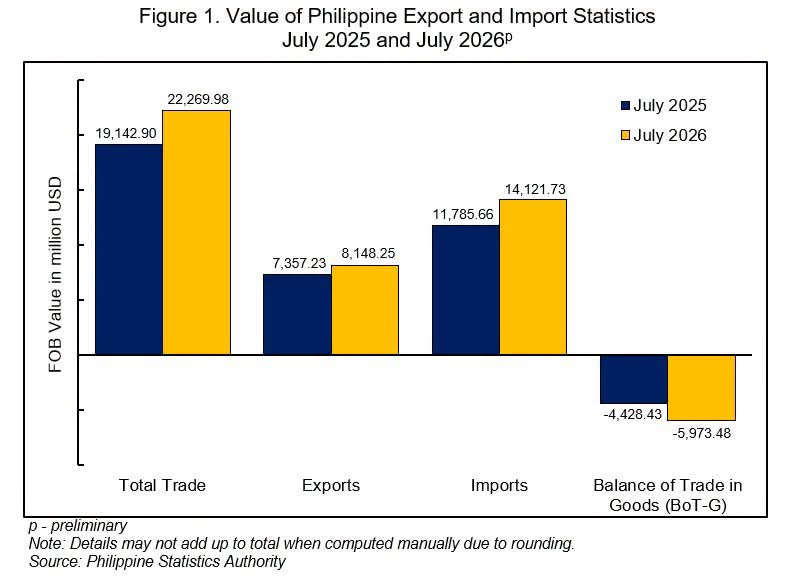
The Philippines’ trade deficit widened sharply in July as imports continued to outpace exports, with the country’s merchandise trade gap expanding by nearly 35 percent from a year earlier, according to the Philippine Statistics Authority.
The balance of trade in goods deficit reached USD5.97 billion, wider than the USD4.43 billion posted in the July 2025 and the USD5.5 billion in June. Total external trade, meanwhile, grew 16.3 percent to USD22.27 billion.
Imports accounted for 63.4 percent of total trade, reaching USD14.12 billion, up 19.8 percent from July 2025. Exports rose at a slower 10.8 percent to USD8.15 billion.
Electronics dominated both sides of the trade ledger. Electronic products generated USD4.79 billion, or 58.8 percent of exports, while also accounted for USD4.60 billion, or 32.6 percent, of imports. The commodity group posted the largest annual increase in export value at USD869.72 million and also led the growth in imports, rising by USD1.75 billion.
The import bill also reflected stronger demand for production and investment. Raw materials and intermediate goods accounted for the largest share at USD5.71 billion, followed by capital goods at USD3.84 billion. Consumer goods accounted for USD2.58 billion.
Mineral fuels, lubricants, and related materials posted the second-largest increase in imports at USD502.71 million, while cereals and cereal preparations rose by USD187.36 million.
China remained the Philippines’ largest import source at USD4.17 billion, followed by South Korea, Japan, Indonesia, and the US.
On the export side, the United States was the biggest market at USD 1.68 billion, followed by Hong Kong, China, Japan, and Singapore.
Despite the wider July gap, the export picture remains relatively bright. January-to-July exports climbed 12.9 percent to USD54.92 billion, the highest for the period since the PSA series began in 1991.
Imports, however, are running even faster. Year-to-date imports surged 18.9 percent to USD92.26 billion, also a record for the period.
The numbers leave the Philippines selling more to the world, but buying considerably more.