Metro Manila’s residential condominium market is beginning to show signs of recovery, largely fueled by sustained demand for affordable housing—even as vacancy rates remain elevated, according to Colliers Philippines.
In the first quarter of 2026, around 2,000 new condominium units were completed, with developments concentrated in Fort Bonifacio, the C5 Corridor, and Alabang.
For the full year, new supply is expected to reach 13,000 units—a 74 percent jump from 2025—with the C5 Corridor likely accounting for a substantial share of completions.
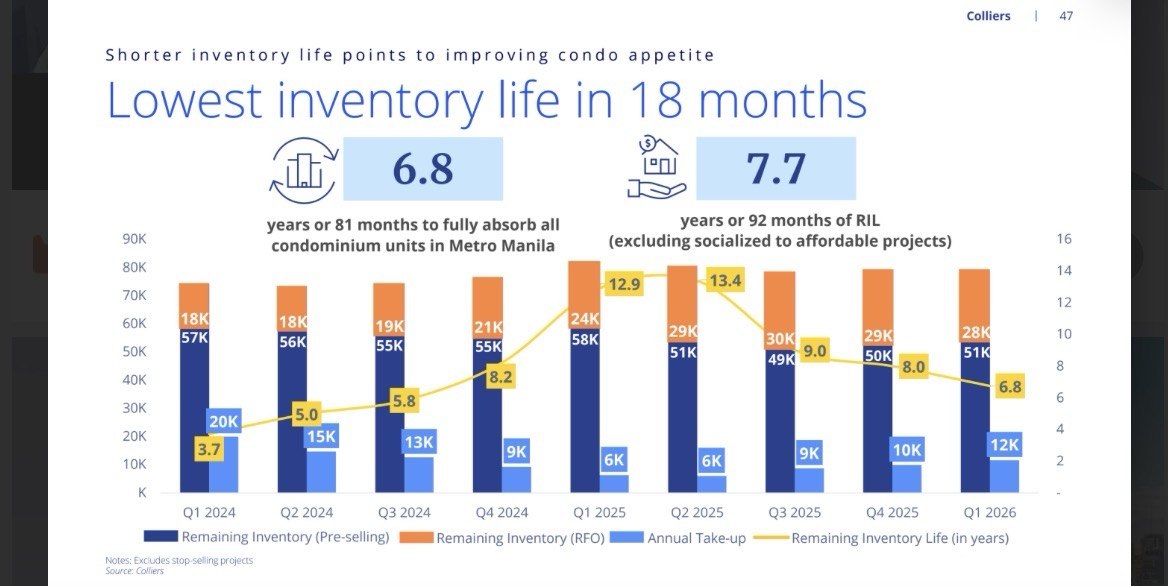
Despite the surge in supply, absorption is gradually improving. Remaining inventory life (RIL)—which estimates how long it will take to sell unsold units—declined to 6.8 years, or 81 months. This easing suggests demand is strengthening, offering a positive signal for the market’s trajectory.
Pre-selling activity also picked up, with 2,000 units taken up in the first quarter alone—a sharp year-on-year increase. Notably, 74 percent of this demand came from the economic and affordable segments, with units priced between P1.8 million and P3.6 million.
This trend underscores how lower-priced developments, supported in part by government initiatives, are anchoring the market’s recovery.
Still, challenges persist. Vacancy rates are projected to reach a record 25.6 percent by the end of 2026, driven by a wave of new completions, particularly in the Bay Area. Unsold inventory remains high at 78,000 units, including 28,000 ready-for-occupancy units.
But the supply pipeline may ease. With fewer project launches during the pandemic, 2026 is expected to mark the peak of heavy completions. Beyond this point, a slowdown in new turnover could help reduce competition and gradually bring the market back into balance.