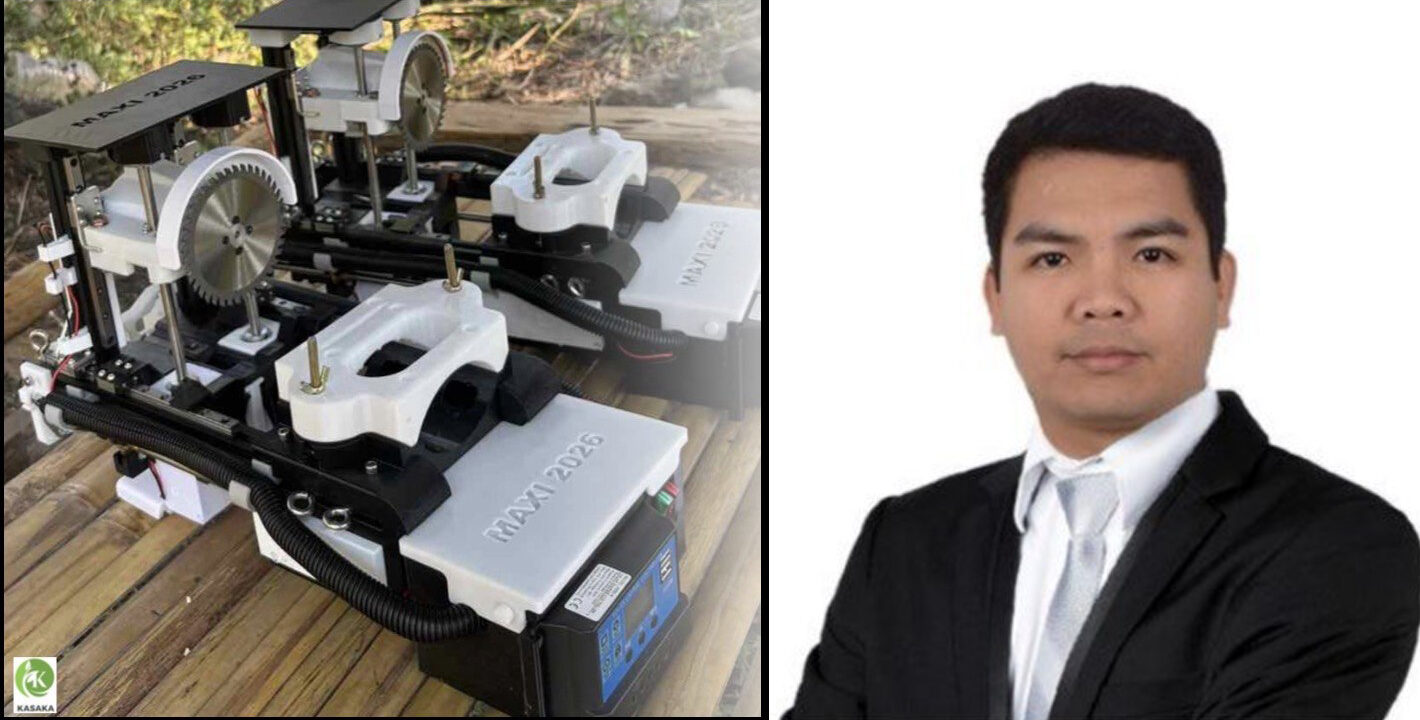
For generations, the work of a mananguete has depended on strong legs, steady hands and a willingness to climb towering coconut trees in the dead of night. For mechanical engineer Arniel “Maxi” Cunahap, it also became the inspiration for a patented invention that could transform one of Philippine agriculture’s most dangerous jobs.
Last week, the Intellectual Property Office of the Philippines granted a patent for Cunahap’s automated coconut sap extraction machine, making it the fourth invention recognized under the World Intellectual Property Organization’s Inventor Assistance Program in the country.
The breakthrough was personal for Cunahap. His father spent years as a mananguete, scaling coconut trees several times a night to collect sap before it spoiled.
“The idea started as our capstone project at AIM,” Cunahap said. “When we visited coconut farms, we saw how physically demanding and risky the work was. Since my father was a mananguete, I knew those challenges firsthand. We asked ourselves: why not build a machine that could do the climbing for them?”
That question evolved into MAXI, a solar-powered device that automatically cuts coconut flowers, harvests sap every four hours and stores it safely, eliminating the need for repeated nighttime climbs.
The invention was hardly an overnight success. The team went through multiple prototypes before arriving at the patented version, with the current design representing the eighth iteration.
They are already refining newer versions, a sign that innovation in agriculture is rarely a one-and-done process. Support from the Department of Science and Technology helped accelerate development and move the project closer to commercialization.
More importantly, the machine tackles a costly problem.
Coconut sap must be collected on schedule, particularly at night, or it begins to ferment and loses value. By automating collection, MAXI helps farmers preserve quality while reducing workplace risks and labor demands.
Rather than selling a P25,000 machine to cash-strapped farmers, Cunahap’s startup, Kasaka Agriventures, adopted an equipment-as-a-service model, earning only when farmers earn more. Farmers keep the majority of additional income generated from higher yields, while the company shares in the gains.
Since commercialization began in late 2024, dozens of units have been deployed in Batangas, with expansion plans underway through partnerships with government agencies and farmer groups.
The patent, Cunahap said, is more than legal protection. It is proof that world-class agricultural innovation can grow from the top of a coconut tree — and from a son determined to make his father’s work safer, more productive and more profitable.