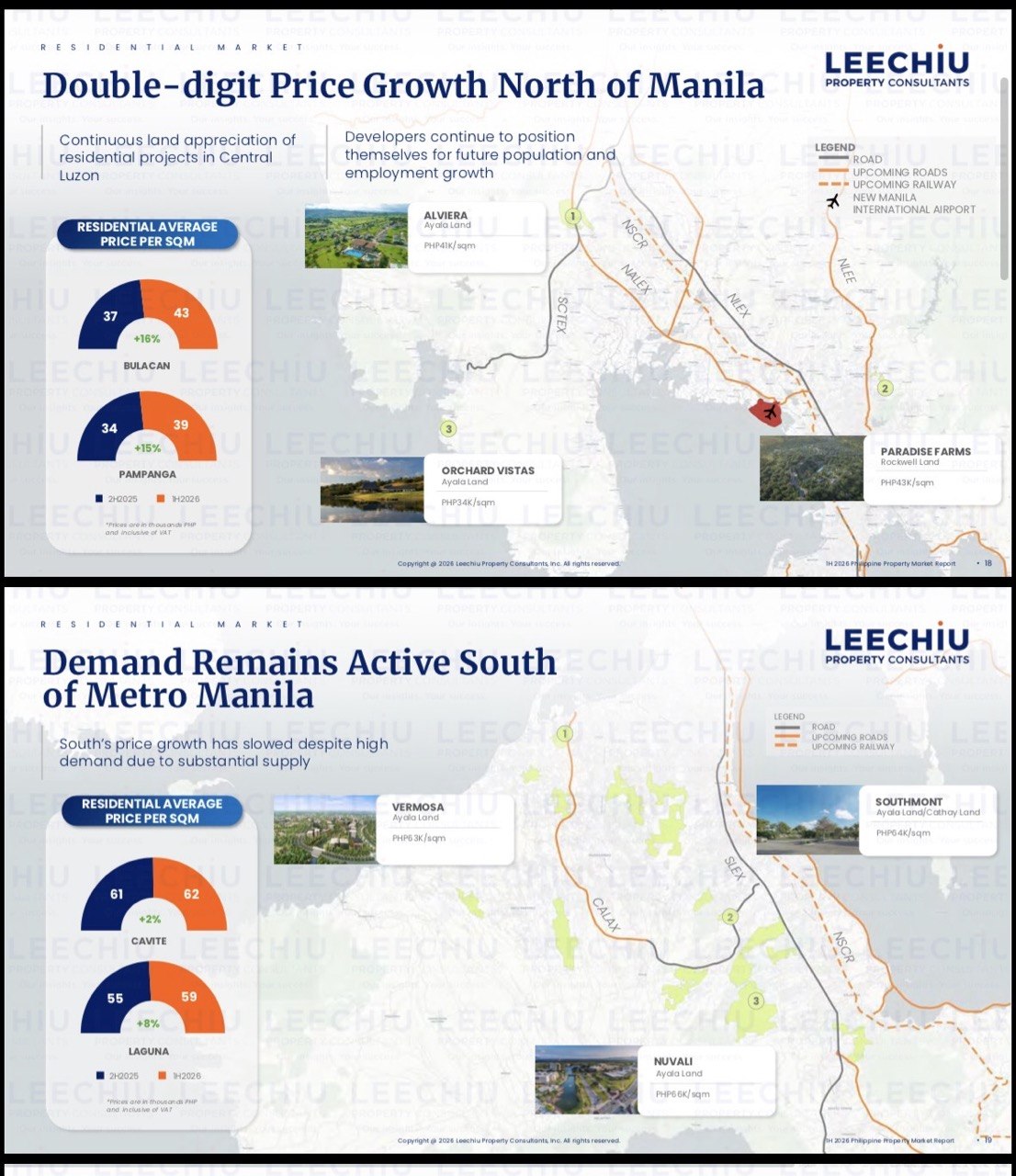
Residential property demand is gathering pace north of Metro Manila, with land values in key Central Luzon growth corridors climbing far faster than in the more established southern market as infrastructure upgrades and industrial investments reshape the country’s next housing hotspots.
According to Leechiu Property Consultants, residential lot prices in Pampanga rose by an average of 15 percent, while Bulacan posted 16 percent growth, reflecting robust demand for township developments across Central Luzon.
“We are seeing higher growth in prices north of Metro Manila. It just indicates that there is now a booming or rising demand for residential township units north of Metro Manila,” said Roy Golez, Leechiu’s Director for Research, Consultancy, and Valuation.
Golez said the surge is being driven by major infrastructure projects, stronger regional connectivity, and expectations of new jobs from artificial intelligence, semiconductor manufacturing, advanced manufacturing, and robotics industries expected under the Pax Silica initiative.
Developers are already moving to secure strategic landholdings around New Clark City and the Subic-Clark-Tarlac Expressway corridor in anticipation of fresh investment inflows, he said. While Pax Silica’s biggest impact on land prices is expected within and around the development zone, Golez noted that the broader Central Luzon property market is already benefiting from expanding industrial estates and infrastructure spending.
The pricing gap also highlights the north’s growth potential. Residential township lots in northern developments now average P43,000 to P45,000 per square meter, compared with P59,000 to P62,000 per square meter in southern growth areas, where annual appreciation has cooled to just 2 percent to 6 percent as those markets mature.
Still, Golez warned that sustaining the region’s property upswing will depend on one critical factor. He said the success of Pax Silica and the pipeline of planned data centers will require thousands of megawatts of new power capacity, making electricity supply the industry’s biggest bottleneck.