The Philippine information technology and business process management (IT-BPM) industry is recalibrating its growth strategy, shifting its focus from expanding headcount to building an artificial intelligence-ready workforce as it targets more than USD50 billion in annual revenues by 2028.
The IT and Business Process Association of the Philippines (IBPAP) on Tuesday unveiled its refreshed industry roadmap, reflecting the rapid rise of artificial intelligence, intensifying competition from emerging outsourcing hubs and a more uncertain global business environment.
IBPAP President and Chief Executive Officer Jack Madrid said the industry’s future competitiveness will depend less on the number of workers it employs and more on whether Filipino talent can effectively harness AI.
“Our vision is a Philippine IT-BPM industry powered by 2 million AI-enabled digital Filipino workers. The most important word there is AI-enabled. It is not so much the number—we are not just talking about jobs or workers, but workers equipped with AI capabilities,” Madrid said.
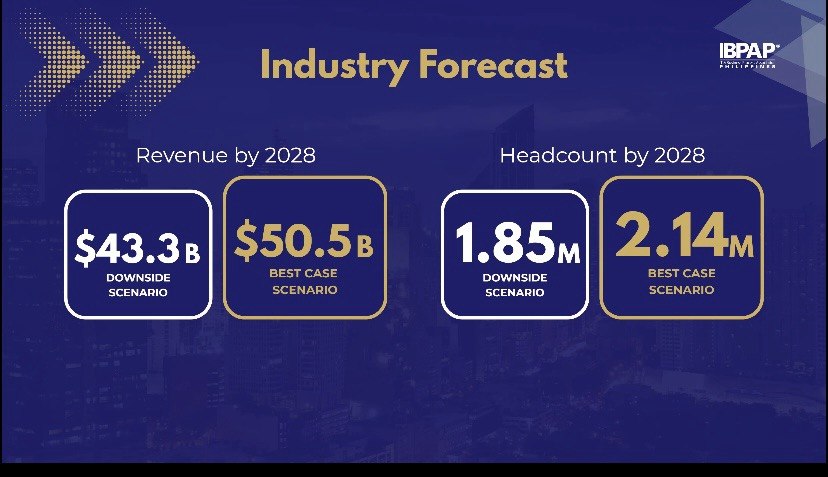
Under the updated roadmap, the industry’s best-case scenario projects revenues exceeding USD50 billion by 2028 with 2.14 million AI-enabled workers. A downside scenario sees revenues reaching only USD43 billion while employment slips to 1.85 million if the sector fails to adapt quickly to AI-driven changes.
The revised revenue target is lower than the USD58 billion goal set when the original roadmap was drafted in 2022, reflecting a more measured outlook amid technological disruption and geopolitical uncertainty.
IBPAP expects the industry to close 2026 with USD42.3 billion in revenues and 1.95 million employees, up from USD40 billion and 1.89 million workers in 2025.
Madrid said maintaining the Philippines’ position as the world’s second-largest IT-BPM destination will require stronger collaboration among government, industry, academe and workers, alongside reforms that improve the country’s investment climate.
He cited regulatory bottlenecks and ease-of-doing-business concerns as issues that continue to weigh on investor sentiment.
“The future of the industry remains promising, but how we continue to grow will change,” Madrid said. “The challenge before us is whether we can move fast enough to capture this next wave of opportunity.”
The roadmap signals that the next chapter of the outsourcing industry will be defined not by scale alone, but by how successfully Filipino workers evolve alongside artificial intelligence.