The Philippines’ near-term growth outlook remains subdued, but easing inflation could offer policymakers more room to support the economy as global headwinds begin to soften.
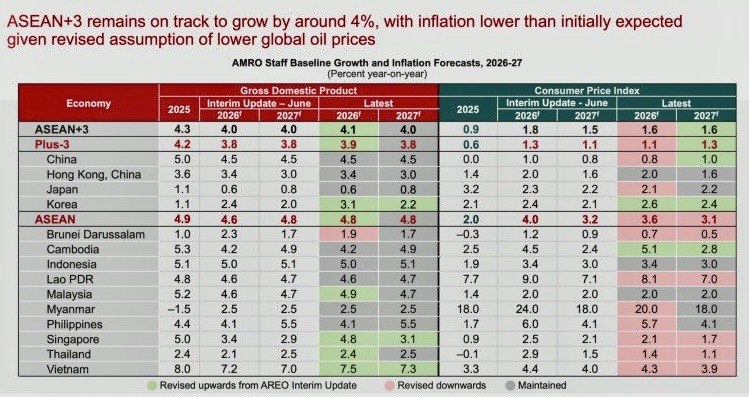
The ASEAN+3 Macroeconomic Research Office (AMRO) kept its Philippine gross domestic product (GDP) growth forecast unchanged at 4.1 percent for 2026 in its July regional update, while maintaining its 2027 projection at 5.5 percent. Although this year’s forecast ranks the Philippines as the fourth slowest-growing economy in ASEAN, next year’s outlook would make it the region’s second fastest-growing economy, trailing only Vietnam.
The more notable revision came on inflation. AMRO lowered its 2026 forecast for the Philippines to 5.7 percent from 6.0 percent, citing easing global commodity prices, while leaving its 2027 projection unchanged at 4.1 percent.
The adjustment suggests the country’s inflation battle may be becoming more manageable even as economic growth remains constrained. Lower commodity prices could help ease pressure on consumers and businesses while giving the Bangko Sentral ng Pilipinas greater flexibility in calibrating monetary policy if price pressures continue to moderate.
Across the broader ASEAN+3 region, AMRO slightly raised its 2026 growth forecast to 4.1 percent from 4.0 percent, with growth expected to ease to 4.0 percent in 2027. Regional inflation is now projected at 1.6 percent this year, down from the previous estimate of 1.8 percent.
AMRO said the region continues to benefit from strong demand for semiconductors and artificial intelligence-related products, resilient household spending, robust investment and healthy electronics exports. It also noted that disruptions to energy and industrial supply chains from tensions in the Middle East have proved less severe than initially feared.
Still, the regional think tank cautioned that risks remain tilted to the downside. A renewed escalation of geopolitical conflicts, weaker demand for AI-related products, rising trade protectionism and heightened financial market volatility could derail growth and rekindle inflationary pressures, underscoring how closely the Philippines’ economic trajectory remains tied to global developments.