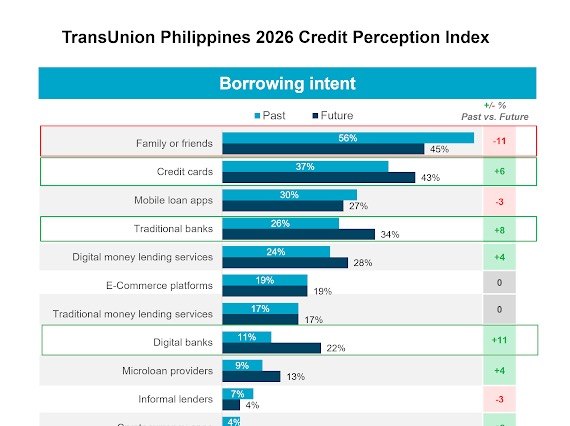
Filipinos are showing stronger trust in formal credit and digital financial services even as their outlook on household finances weakens, pointing to a maturing credit market amid persistent inflation and cost-of-living pressures, according to TransUnion’s 2026 Credit Perception Index.
The Philippines’ Credit Perception Index score rose to a record 75 out of 100, the highest since the study began in 2023. The gain was driven by stronger favorability, product trust, and product knowledge, suggesting consumers are becoming more familiar and comfortable with credit.
That confidence, however, is not translating into a brighter near-term financial outlook. Only 64 percent of respondents expect their finances to improve over the next three months, while 73 percent expect improvement over the next year. Both figures fell three percentage points from 2025.
Inflation, rising living costs, and energy prices remained the biggest concerns.
Still, Filipinos are taking a more proactive approach to managing their finances. Some 86 percent plan to save, while 73 percent intend to seek financial education and 70 percent plan to explore digital financial products. Another 43 percent expect to borrow or use credit for purchases in the near term.
Digital banks are emerging as a major beneficiary. Intent to borrow from digital banks rose 11 percentage points, ahead of traditional banks at 8 points and credit cards at 6 points. More than half of Filipinos now use digital banks, with their knowledge, favorability, and perceived safety scores posting double-digit gains.
The findings point to expanding opportunities for financial institutions, but also raise the bar for consumer protection.
One in four Filipinos still struggles to find reliable credit information, highlighting the need for greater transparency, fair pricing, stronger fraud protection, and financial education as lenders compete for increasingly digital consumers.
For the financial industry, the message is clear. Consumers may be worried about their finances, but they are becoming more willing to engage with formal credit when they understand and trust the products.