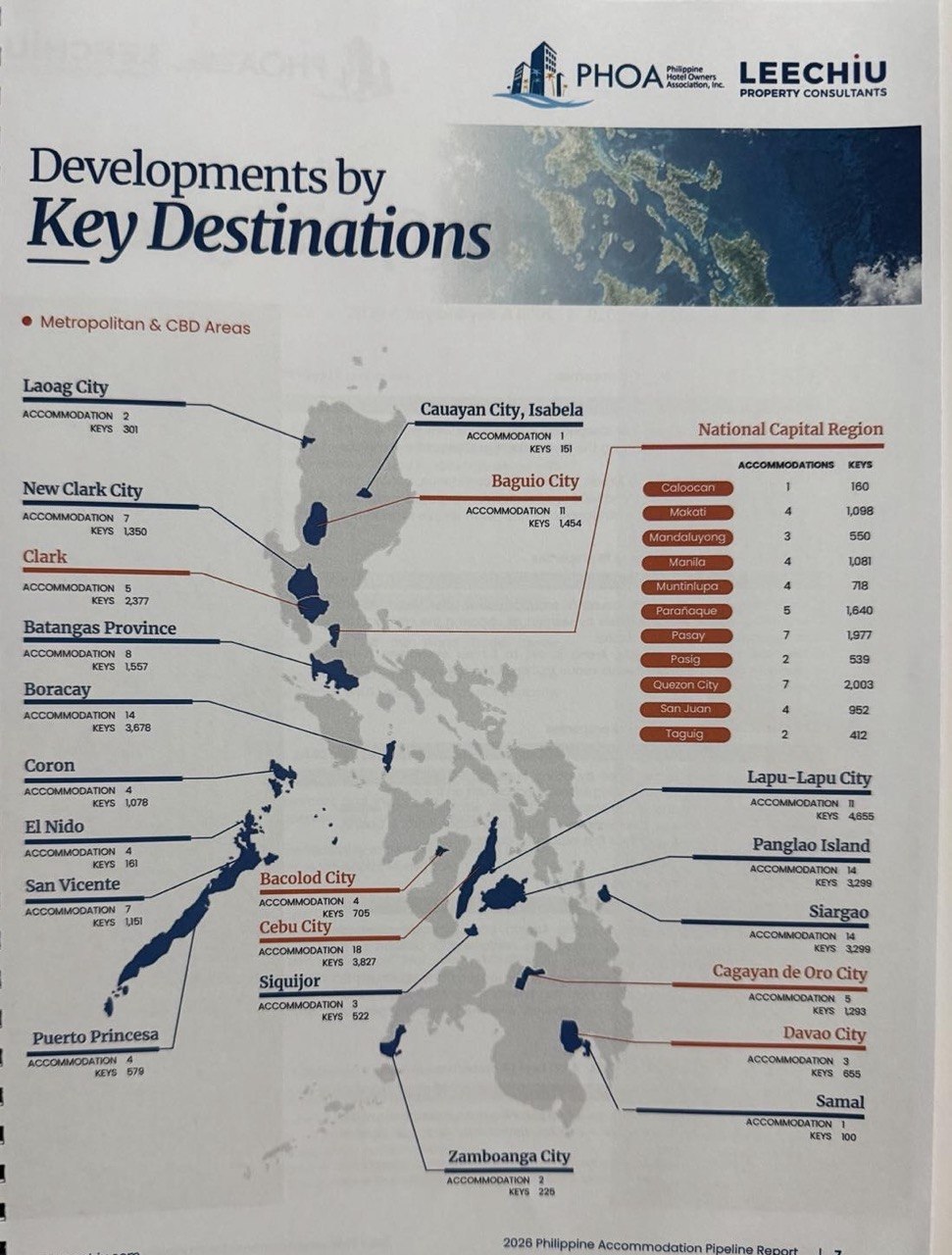
The Philippine hotel industry has lined up P387 billion in committed investments for more than 45,000 new rooms through 2032, signaling sustained developer confidence in tourism despite sharply higher construction and financing costs.
A joint Philippine Hotel Owners Association and Leechiu Property Consultants (LPC) report identified 45,213 room keys across 213 accommodation projects scheduled from 2026 to 2032.
The pipeline has expanded substantially from 2024, when LPC identified about 40,000 rooms across 158 properties involving P250 billion in investments.
The number of planned properties has since risen 35 percent, while room supply grew 14 percent, pointing to a pipeline increasingly spread across more projects and destinations rather than concentrated in larger developments.
“I think the pipeline’s very healthy. The support at a local level, domestically, is very strong, and it bodes well for the future as we move ahead,” said Alfred Lay, LPC director for Hotels, Tourism and Leisure.
The planned projects are expected to create more than 64,000 direct hotel jobs, extending the economic impact of tourism development beyond Metro Manila.
The pace of openings is projected to accelerate through 2028, which Lay described as a pivotal year, with around 12,000 rooms expected to open during that year alone.
Location is also becoming a central feature of hotel investment. About 70 percent of the nationwide pipeline is located near international gateways, linking future room supply to airports, transport infrastructure, and expanding economic activity.
“Where infrastructure goes, hotels will follow,” Lay said.
The P387-billion pipeline is particularly notable given that construction costs have risen by about 30 percent over the past two years and financing has become more expensive.
Yet developers continue to commit capital to new hotels, reflecting expectations that domestic travel, international arrivals, and business activity will sustain demand over the longer term.
Lay said the investment pipeline shows developers are still “putting their money where their mouth is.”
The challenge now is execution. With thousands of rooms scheduled to enter the market, especially from 2028, hotel demand will need to keep pace with the rapid expansion in supply for the investment pipeline to deliver the returns developers expect.