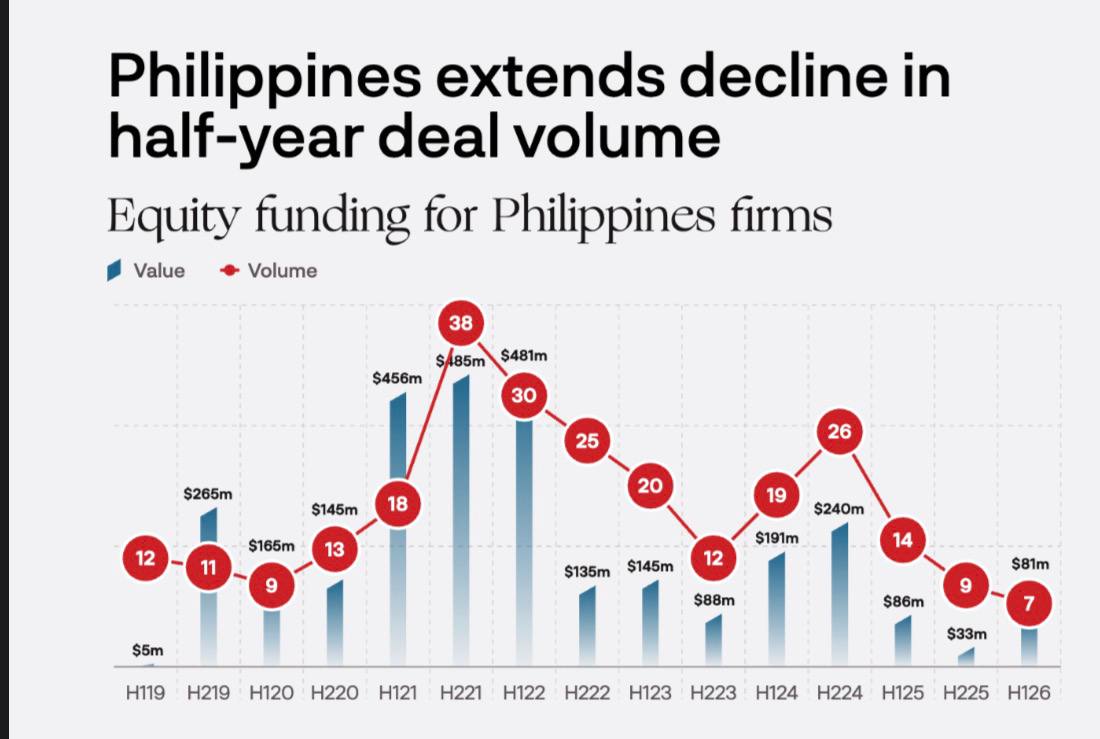
Philippine startup funding more than doubled in the first half of 2026, but a shrinking number of transactions revealed a market increasingly reliant on a few large deals rather than broad-based investor participation.
The country attracted USD81 million in startup investments, up 145 percent from the preceding semester, according to the H1 2026 Southeast Asian Startup Funding Report by Kickstart Ventures and DealStreetAsia. Yet only seven Philippine startups raised funding, down from nine in the previous six-month period and marking the lowest deal activity since 2019.
The disparity highlights a persistent challenge for the local startup ecosystem: higher funding totals do not necessarily signal deeper capital markets or easier access to financing for emerging businesses.
Fintech accounted for USD61 million, or roughly 75 percent, of total Philippine startup funding. Digital financial services company Salmon secured USD50 million, representing nearly 62 percent of the national total. Together, Salmon and Sprout accounted for USD70 million, or about 86 percent of all disclosed funding.
The concentration leaves limited evidence of capital reaching startups across a broader range of industries. The Philippines captured just 1.1 percent of Southeast Asia’s USD7.25 billion in startup funding and 3.2 percent of the region’s 217 deals during the period.
Kickstart Ventures partner Jecky Pelaez said closing the funding gap would require stronger corporate participation, with businesses helping startups access customers, distribution networks and commercial opportunities—not merely providing capital.
“We’re seeing this as a commercial opportunity as much as a capital one. One of the reasons startups stall is that they can’t reach the customers that would prove the business,” Pelaez said.
The report also recorded a return of late-stage healthcare investment after a year-long absence, offering a sign of continued investor appetite beyond early-stage ventures.
Still, the broader picture remains uneven. Without more transactions, greater sector diversity and stronger pathways to commercial growth, headline funding gains may mask the difficulties startups face in securing capital and scaling their businesses.